
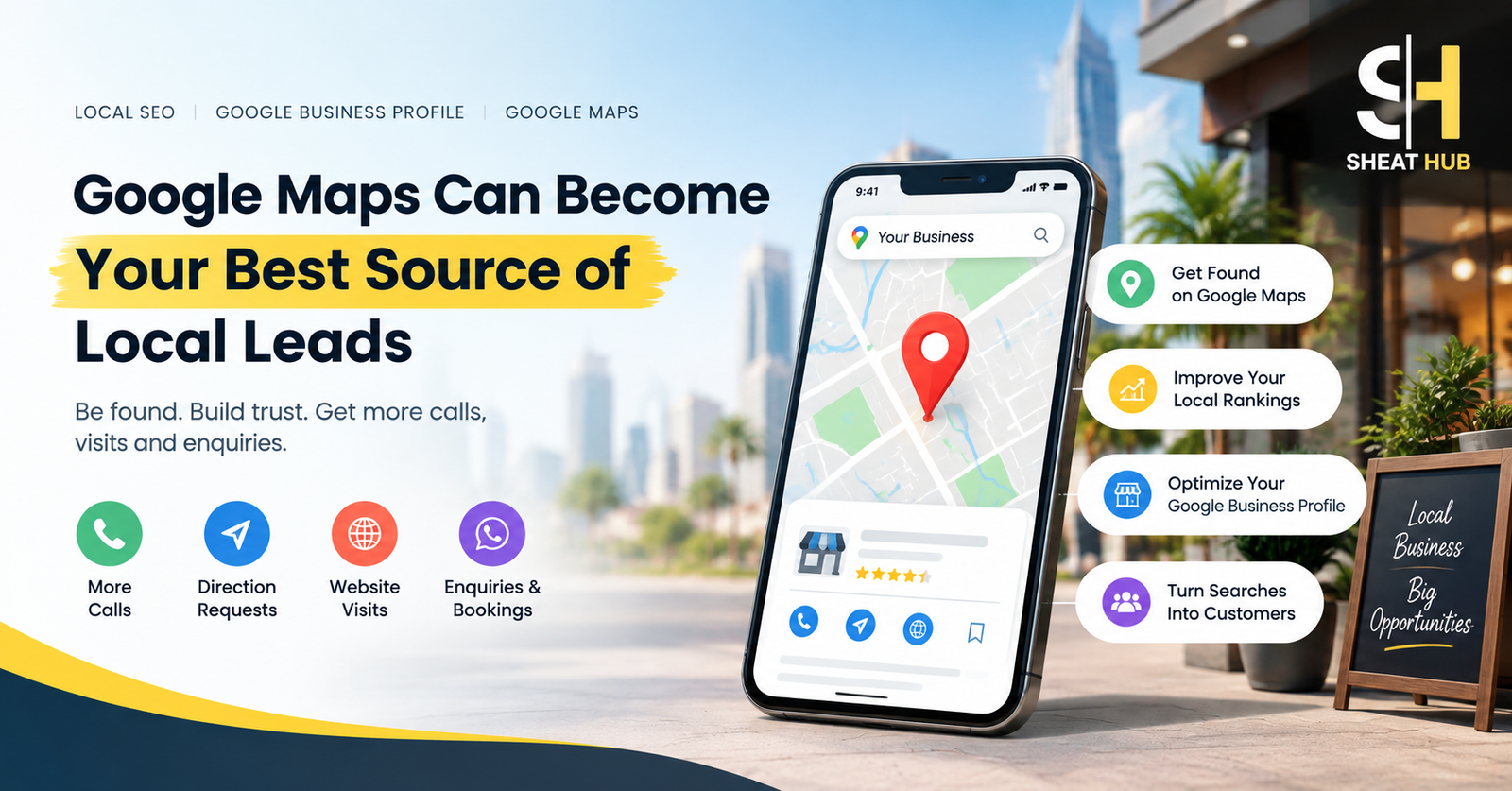
Google Maps Can Become Your Best Source of Local Leads
When people need a nearby restaurant, dentist, contractor, salon, repair service, clinic, or other local business, one of the first places they turn to is Google.
And for many of these searches, Google Maps appears before traditional website results.
That makes Google Maps more than just a tool for finding directions. For local businesses, it can become an important source of local leads, phone calls, website visits, direction requests, bookings, and enquiries.
But simply having a Google Business Profile does not guarantee visibility.
Your business profile needs accurate information, relevant categories, useful services, good reviews, fresh content, strong local relevance, and a website that supports your local search presence.
This is where Google Maps SEO and Local SEO become important.
Why Google Maps Matters for Local Businesses
Imagine someone searches:
“plumber near me”
or
“best family dentist in Dubai”
or
“restaurant near me”
Google needs to decide which local businesses are most relevant to that search.
The businesses that appear in the local results have an opportunity to reach people who are already looking for what they offer.
That is different from simply showing an advertisement to someone who may or may not need your service.
A person searching for a service on Google often has a specific problem or requirement.
That search can turn into:
- A phone call
- A WhatsApp enquiry
- A website visit
- A direction request
- A booking
- A store visit
- A quotation request
This is why Google Maps visibility can have a direct connection with local lead generation.
What Is Google Maps SEO?
Google Maps SEO is the process of improving a business’s visibility in Google’s local search and Maps results.
It is closely connected with Local SEO and Google Business Profile optimization.
The goal isn’t simply to get a business listed on Google.
The goal is to make the business easier for the right local customers to discover and contact.
Google Maps SEO Includes More Than Rankings
A strong local search strategy can involve:
- Google Business Profile optimization
- Correct primary and secondary categories
- Accurate business information
- Service and product optimization
- Local keyword targeting
- Customer reviews
- Local citations
- Website optimization
- Location pages
- Internal linking
- Local content
- Technical SEO
- On-page SEO
- Business photos and videos
- Google Posts
- Consistent business information
- Conversion-focused contact options
Each part supports the overall local search presence.
How Google Maps Can Generate Local Leads
Google Maps can connect your business with people who are actively searching for a product or service in a particular location.
For example, a person searching for:
“AC repair in Sharjah”
is already showing an interest in AC repair.
If your business appears prominently in the local results and your profile gives the visitor enough confidence, that search can become an enquiry.
1. Customers Can Call Directly
A properly optimized Google Business Profile can make it easy for customers to call your business.
This is particularly useful for businesses where customers usually want quick answers.
Examples include:
- Plumbers
- Electricians
- Cleaning companies
- Clinics
- Dentists
- Restaurants
- Car repair businesses
- Construction companies
- Home maintenance services
The customer doesn’t necessarily need to visit your website first.
They can discover your business and call directly.
2. Customers Can Request Directions
For businesses with a physical location, Google Maps can help customers find the business quickly.
A customer may search for a nearby service, compare several businesses, and then request directions to the one they choose.
Accurate location information therefore matters.
Your address, map pin, business hours, phone number, and other details should be correct and consistent.
3. Customers Can Visit Your Website
Your Google Business Profile can also send users to your website.
This gives you another opportunity to turn search traffic into enquiries.
But there is an important point here.
Getting a website click isn’t the same as getting a lead.
Your website needs to make the next step obvious.
A visitor should be able to quickly understand:
- What you offer
- Where you operate
- Why they should contact you
- How to contact you
- What action they should take next
A clear phone number, WhatsApp button, enquiry form, booking option, or quotation request can reduce friction.
The Importance of Your Google Business Profile
Your Google Business Profile (GBP) is one of the most important parts of a local search strategy.
It gives Google and potential customers information about your business.
A neglected profile can create missed opportunities.
Important Google Business Profile Elements
Your profile should be reviewed regularly for:
- Business name
- Primary category
- Secondary categories
- Business description
- Services
- Products, where relevant
- Business hours
- Website URL
- Phone number
- Address or service area
- Photos
- Videos
- Customer reviews
- Review responses
- Google Posts
- Frequently asked questions, where available
The objective is not to fill every field with keywords.
The objective is to provide accurate, useful information that clearly explains what your business does.
Why Google Business Profile Categories Matter
Your business category helps Google understand what your business is.
Choosing an inappropriate primary category can make it harder to build relevance for important local searches.
For example, a business may provide several services, but its primary category should accurately represent its main business.
Secondary categories can then help describe other relevant services.
Category selection should be based on the actual business and the categories available in Google’s system, not simply on keywords a business wants to rank for.
Reviews Can Influence Customer Decisions
When people compare local businesses, reviews can play an important role.
Think about your own behaviour.
If you see two businesses offering similar services, you may look at:
- Overall rating
- Number of reviews
- Recent reviews
- What customers actually said
- How the business responds to complaints
- Whether customers mention the service they received
This is why review management should be part of a broader Local SEO strategy.
Don’t Just Ask for More Reviews
A better approach is to create a consistent process for requesting genuine customer feedback.
Reviews should reflect real customer experiences.
Businesses should also respond professionally to reviews, including negative ones.
A thoughtful response can show potential customers that the business pays attention to customer feedback.
Your Website and Google Maps Should Work Together
One common mistake is treating Google Business Profile and the website as completely separate marketing channels.
They should support each other.
Your Google Business Profile can introduce a customer to your business.
Your website can then provide more detailed information and encourage the customer to take action.
Your Website Should Support Local Search
A local business website should clearly communicate:
- Business location
- Service areas
- Main services
- Contact information
- Opening hours
- Service details
- Customer FAQs
- Trust signals
- Reviews or testimonials
- Clear calls to action
For businesses serving multiple areas, useful location or service-area pages may also help create a stronger local search structure when those pages contain genuinely useful information.
Local Keywords Need the Right Strategy
Using local keywords doesn’t mean repeating the city name throughout every paragraph.
That can make content unnatural and provide a poor user experience.
Instead, local keywords should appear naturally in relevant areas such as:
- Page titles
- Headings
- Service pages
- Location pages
- Meta descriptions
- Image alt text where appropriate
- Internal links
- Google Business Profile services
- Supporting local content
Examples of Local Keywords
Depending on the business, keyword targets might include:
- Local SEO services in Dubai
- Dentist in Sharjah
- AC repair in Dubai
- Construction company in Abu Dhabi
- Restaurant near me
- Electrician in Sharjah
- Digital marketing agency in Dubai
- Google Business Profile optimization
- Local SEO services
- Google Maps SEO
The right keywords depend on what customers actually search for and the services the business genuinely provides.
Why NAP Consistency Still Matters
NAP stands for:
Name, Address, Phone Number
Your business information should be accurate and consistent across important online platforms.
For example, if your website shows one phone number while an online directory shows another, it can create confusion for customers.
Check important business listings for:
- Business name
- Address
- Phone number
- Website
- Business category
Correct outdated information wherever possible.
Google Maps Visibility Is Not Only About Rankings
A business can appear on Google Maps and still generate very few leads.
Why?
Because visibility is only one part of the process.
Consider what happens after someone sees your listing.
They may compare:
- Reviews
- Photos
- Services
- Opening hours
- Website
- Location
- Contact options
- Other businesses nearby
This means your Google Maps presence should also be designed to build trust.
Visibility + Trust + Action
A simple way to think about local lead generation is:
Visibility → Trust → Action → Lead
If customers can’t find you, there is no opportunity.
If they find you but don’t trust the business, they may choose someone else.
If they trust you but can’t easily contact you, the opportunity can still be lost.
Common Google Maps Mistakes Businesses Make
Many businesses create their Google Business Profile and then leave it untouched.
That can be a problem.
Here are some common issues:
1. Incorrect Business Category
The selected category doesn’t accurately represent the business.
2. Incomplete Services
Important services aren’t properly listed.
3. Outdated Information
Opening hours, phone numbers, website links, or other information may be outdated.
4. Poor Quality Photos
The profile has few photos or uses outdated images.
5. No Review Strategy
The business receives reviews occasionally but has no consistent process for collecting genuine customer feedback.
6. No Review Responses
Customer reviews are left unanswered.
7. Weak Website
The Google listing links to a website that is slow, unclear, outdated, or difficult to navigate.
8. Missing Local Content
The website doesn’t clearly explain the areas or locations the business serves.
9. Weak Calls to Action
Visitors don’t have an obvious way to call, message, book, or request a quote.
10. No Regular Monitoring
The business doesn’t regularly check how its local search presence is performing.
How to Improve Your Google Maps Lead Generation
If you want Google Maps to become a stronger source of local leads, start with the basics.
Step 1: Audit Your Google Business Profile
Review your:
- Category
- Services
- Description
- Contact details
- Business hours
- Website
- Photos
- Reviews
- Location
- Service areas
Look for missing, outdated, or inaccurate information.
Step 2: Review Your Local Competitors
Search for your main services on Google Maps.
Look at businesses that appear in the local results.
Review their:
- Categories
- Services
- Reviews
- Photos
- Website
- Content
- Customer experience
The goal isn’t to copy competitors.
It is to identify gaps and opportunities.
Step 3: Improve Your Website
Make sure your website supports the searches you want to attract.
Create useful service pages and location content where appropriate.
Make contact options easy to find.
Step 4: Build a Review Process
Ask genuine customers for feedback after providing a service.
Make the process simple.
Respond to reviews professionally.
Step 5: Keep Your Profile Active
Update photos and publish useful Google Business Profile content when appropriate.
Your activity should be useful to customers, not just done for the sake of activity.
Step 6: Track Leads, Not Just Rankings
Don’t focus only on where your business appears.
Track actions such as:
- Phone calls
- Website clicks
- Direction requests
- Form submissions
- WhatsApp enquiries
- Bookings
- Quote requests
The real question is not simply:
“Did we rank?”
It is:
“Did our visibility help generate business?”
Google Maps and AI Search Are Becoming More Connected
Local search is also changing.
People increasingly use conversational search and AI-powered search tools to find businesses, services, and recommendations.
This makes it important for businesses to maintain accurate, useful, and consistent information across their website and online business profiles.
Your local SEO strategy should therefore consider more than traditional keyword rankings.
It should also focus on:
- Clear business information
- Helpful service content
- Strong topical relevance
- Structured website content
- Local context
- FAQs
- Consistent business information
- Good user experience
This supports broader SEO, AEO, GEO, and AI search visibility efforts.
A Simple Google Maps Lead Generation Checklist
Before expecting more leads from Google Maps, check the following:
Google Business Profile
- Correct business category
- Complete business information
- Accurate opening hours
- Relevant services added
- Correct website URL
- Correct phone number
- Accurate location
- Good quality photos
- Genuine customer reviews
- Professional review responses
Website
- Clear service pages
- Location information
- Local keyword targeting
- Fast mobile experience
- Clear contact details
- WhatsApp or call option where appropriate
- Strong calls to action
- Useful FAQs
- Internal linking
- Technical SEO
Lead Generation
- Track phone calls
- Track website enquiries
- Track bookings
- Track quotation requests
- Monitor Google Business Profile performance
- Review competitors regularly
Final Thoughts
Google Maps can be much more than a location tool.
For a local business, it can become an important part of the customer journey, from the first search to the final enquiry.
But getting more local leads isn’t about simply creating a Google Business Profile and waiting for customers.
Your Google Business Profile, website, reviews, Local SEO, content, and conversion strategy need to work together.
If customers are searching for your services but your business isn’t visible, complete, trustworthy, or easy to contact, you may be losing enquiries before they ever reach you.
The first step is simple:
Search for your own business on Google Maps.
Look at your profile the way a potential customer would.
Then ask yourself:
Would I choose this business based on what I see?
That simple check can reveal opportunities that are easy to overlook.
Frequently Asked Questions
What is Google Maps SEO?
Google Maps SEO is the process of improving a business’s visibility in Google Maps and local search results by optimizing its Google Business Profile, website, reviews, local relevance, and related signals.
Can Google Maps generate leads?
Yes. A well-managed Google Business Profile can help potential customers discover a business, call, visit its website, request directions, make bookings, or send enquiries.
Is Google Business Profile optimization part of Local SEO?
Yes. Google Business Profile optimization is an important part of Local SEO, particularly for businesses that serve specific geographic areas.
How long does Google Maps SEO take?
There is no fixed timeframe. Results depend on factors such as the market, competition, business location, website quality, profile history, reviews, relevance, and the overall quality of the local SEO work.
Do reviews help local businesses?
Reviews can help potential customers evaluate a business and can be an important part of a local business’s online presence. Businesses should focus on earning genuine reviews from real customers rather than using artificial or misleading review practices.
Should my website and Google Business Profile have the same information?
Important business information should be accurate and consistent. This includes the business name, address, phone number, website, opening hours, and core services where applicable.
Can Local SEO help businesses get more enquiries?
Local SEO can improve a business’s visibility when people search for relevant services in a particular area. More visibility can create more opportunities for calls, website visits, bookings, and enquiries, although results vary by business and market.
Need Help Improving Your Local Visibility?
If your business isn’t getting enough enquiries from Google Maps, it may be time to look beyond the profile itself.
A Local SEO and Google Business Profile audit can identify issues affecting your visibility, website performance, local relevance, and customer conversion path.
SHEAT HUB helps businesses improve their online presence through Local SEO, Google Business Profile optimization, website SEO, technical SEO, and conversion-focused website improvements.
Grow Smarter. Rank Higher. Convert Faster.