
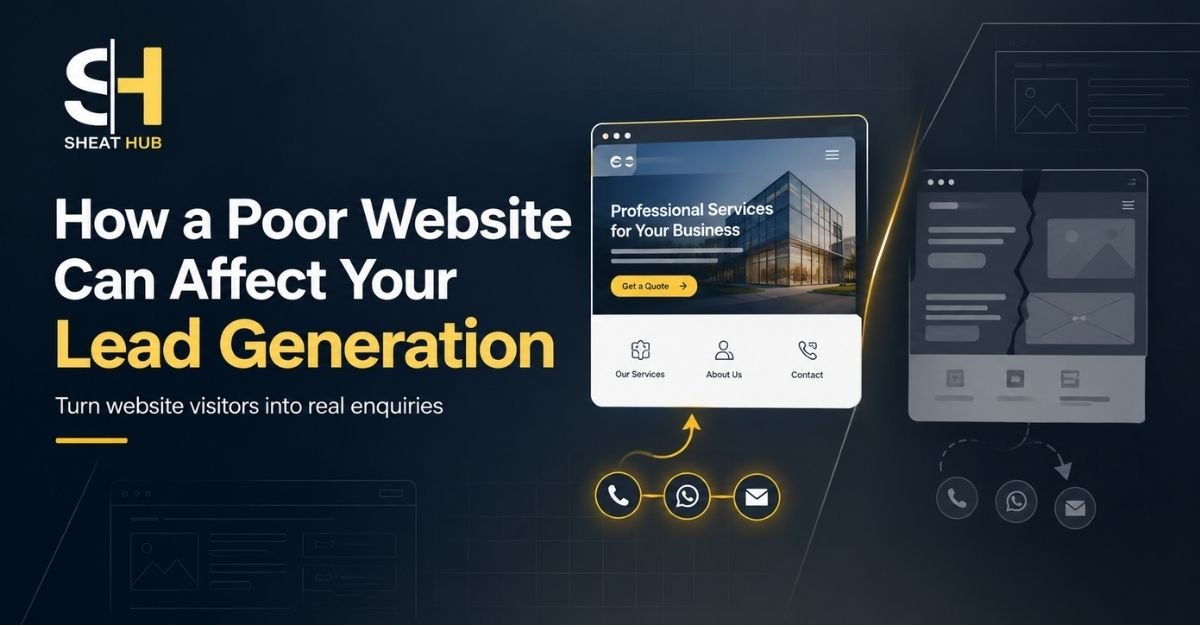
How a Poor Website Can Affect Your Lead Generation
A website can bring potential customers to your business, but it can also quietly send them away. If your pages load slowly, your services are unclear, your contact options are difficult to find, or your website looks outdated on mobile, visitors may leave before they ever become leads.
For businesses in Ajman, this matters because customers often compare several service providers before making contact. Someone searching for a service in Ajman may visit your website after finding you through Google Search, Google Maps, social media, or a recommendation. If the website fails to build confidence quickly, that potential customer can move on to another business.
A poor website doesn’t only affect design. It can affect SEO, local visibility, conversions, enquiries, and how your business information is understood by search engines and AI-powered search experiences.
What Does a Poor Website Look Like?
A poor website isn’t necessarily one that looks old. A modern-looking website can still perform badly if it doesn’t help visitors take action.
Common problems include:
- Slow-loading pages
- Poor mobile experience
- Unclear service descriptions
- Weak or missing calls to action
- Complicated contact forms
- Broken links or buttons
- Low-quality images
- Missing business information
- Thin or duplicated content
- Weak page titles and headings
- No clear location or service area information
- Difficult navigation
- Lack of trust signals such as reviews, certifications, project information, or business details
The biggest problem is that these issues often work together. A visitor might tolerate one small inconvenience, but several problems can make contacting the business feel like unnecessary work.
How a Poor Website Reduces Your Leads
1. Visitors Don’t Understand What You Offer
When someone lands on your website, they should quickly understand what you do, who you serve, and what they should do next.
If your homepage only says something vague such as “Welcome to our company”, it doesn’t help a potential customer make a decision.
A better approach is to clearly explain your main service, target customer, location, and next step.
For example, a service business targeting Ajman could make its homepage immediately clear about the services it provides and the areas it serves.
2. Slow Pages Can Damage the User Experience
People don’t want to wait around for a page to load before finding basic information.
Large images, unnecessary scripts, poorly configured WordPress websites, excessive plugins, and weak hosting can all contribute to technical problems.
Google also recommends paying attention to page experience, including Core Web Vitals, mobile usability, security, and intrusive page elements. Good page experience isn’t a guarantee of high rankings, but it is an important part of creating a useful website experience.
For lead generation, the practical goal is simple: make it easy for a visitor to reach the information and action they need.
3. Mobile Problems Can Cost Enquiries
A potential customer may discover your business while using a smartphone. If the text is too small, buttons are difficult to tap, forms are awkward, or the page requires excessive scrolling, the visitor may leave.
Check your website on several mobile screen sizes. Don’t only check whether it technically opens. Test whether someone can:
- Understand your main service.
- Find your phone number.
- Send a WhatsApp enquiry.
- Complete a form.
- Find your location.
- Read important service information.
If these actions aren’t easy, your website needs work.
Your Website and Local SEO Are Connected
Your website is an important part of your local search presence. Google uses information from websites and other sources when understanding businesses and displaying local results.
Google states that local results are mainly influenced by relevance, distance, and prominence. Complete and accurate business information can help Google better understand what a business offers and match it with relevant searches.
This means a website shouldn’t simply mention “Ajman” repeatedly.
Instead, build useful local relevance through genuine information such as:
- Services available in Ajman
- Relevant service areas
- Clear business contact details
- Location information where appropriate
- Service-specific pages
- Helpful local questions and answers
- Consistent business information
- Useful content that addresses customer problems
This supports Local SEO while also giving visitors the information they need before contacting you.
Poor Content Can Also Reduce Lead Quality
Getting traffic isn’t enough.
Suppose your website receives visitors searching for a specific service, but your page doesn’t explain pricing factors, service scope, process, timelines, or who the service is suitable for.
Visitors may still leave because they don’t have enough information to decide whether your business is right for them.
Strong website content should answer the questions customers are already asking.
For example:
What does the service include?
Who is the service suitable for?
How does the process work?
What information does the customer need to provide?
How can the customer request a quotation or consultation?
This is also where AEO, GEO, and AI search visibility become relevant. Clear, well-structured answers help search systems and AI-powered experiences understand the subject of a page. Your content should be written for people first, while making important information easy for search engines and LLM-based systems to interpret.
Your Calls to Action Matter
One of the most common website mistakes is making visitors guess what to do next.
A lead generation website should provide clear actions such as:
- Request a quotation
- Call now
- Send a WhatsApp message
- Book a consultation
- Request an inspection
- Ask a question
Don’t place one contact button only at the bottom of a long page.
Use relevant calls to action where they make sense, especially after explaining a service or answering an important customer concern.
Build Landing Pages Around Customer Intent
A single homepage shouldn’t have to explain every service in detail.
If your business provides multiple services, create focused pages for important services and search intents.
For example, a business serving customers in Ajman could have separate pages for different services instead of placing everything on one crowded page.
Each page should have:
- A clear title
- One primary topic
- Useful service information
- Relevant local context
- Frequently asked questions
- Trust information
- A clear call to action
- Helpful internal links
This structure can support Website SEO, On Page SEO, Local SEO, and lead generation at the same time.
What Should You Fix First?
If your website isn’t generating enough enquiries, don’t immediately redesign everything.
Start with an audit.
Check:
- Technical performance: Look for slow pages, broken links, indexing problems, mobile issues, and security problems.
- Content: Check whether each important service has enough useful and original information.
- Conversion paths: Test every form, phone link, WhatsApp button, and enquiry process.
- Local SEO: Review your business details, service areas, location signals, and Google Business Profile.
- Trust: Make your experience, reviews, work examples, credentials, policies, and business information easy to understand.
- Search visibility: Review important queries, page titles, headings, internal links, and content gaps.
- AI search readiness: Structure answers clearly so important business and service information can be understood by search systems and LLM-based tools.
Google recommends people-first content that is genuinely useful to the intended audience rather than content created mainly to manipulate search rankings.
How SHEAT HUB Can Help
SHEAT HUB helps businesses improve the parts of their online presence that influence visibility and customer action.
Depending on the business, this can include Website SEO, Technical SEO, On Page SEO, Local SEO, Google Business Profile optimization, WordPress development, website and SEO audits, Google rankings support, AEO, GEO, and AI search visibility.
The first step shouldn’t always be a new website. Sometimes the right solution is fixing technical problems, improving service pages, simplifying the enquiry process, or making the existing website easier to understand.
If your website is receiving visitors but those visitors aren’t turning into enquiries, a proper website and SEO audit can help identify where the process is breaking down.
You can visit SHEAT HUB or contact the team at info@sheathub.com or +971 555 326 286.
FAQs
Can a poor website really reduce leads?
Yes. A website can lose potential leads when visitors can’t quickly understand the service, trust the business, navigate the page, or complete an enquiry. Slow loading, poor mobile usability, confusing navigation, weak content, and difficult contact options can all create friction between website visits and enquiries.
How does website design affect lead generation?
Website design affects how easily visitors find information and complete important actions. A good lead generation website makes services clear, builds trust, works well on mobile devices, and provides obvious next steps such as calling, sending a WhatsApp message, submitting a form, or requesting a quotation.
Does website SEO help generate leads?
SEO can help your pages become more discoverable for relevant searches, but traffic alone doesn’t create leads. The website must also provide useful information and a clear conversion path. SEO, technical improvements, strong service pages, local signals, and conversion-focused content should work together.
Should an Ajman business create location-specific service pages?
It can be useful when the pages serve a genuine customer need. A location page should provide meaningful information about the service and area rather than simply repeating the word Ajman. Avoid creating multiple near-identical pages with only the location name changed.
How do AEO and AI search relate to lead generation?
AEO focuses on making answers easy for search systems to understand and extract. GEO considers visibility in generative search experiences, while structured, useful content can also help LLM-based systems understand your business. These efforts should support useful information rather than replacing traditional SEO and conversion work.
How often should a business website be audited?
There isn’t one schedule that fits every business. A website should be reviewed when performance drops, services change, technical problems appear, or the business isn’t getting the enquiries expected from its online traffic. Regular checks can also identify broken forms, outdated content, indexing issues, and mobile problems.
Do I need a completely new website to get more leads?
Not necessarily. An audit may show that the existing website can perform better with improvements to speed, content, navigation, technical SEO, service pages, calls to action, and mobile usability. Rebuilding is more appropriate when the current platform or structure prevents important improvements.