

Can a Small Business Really Outrank Bigger Competitors on Google?
You search for your main service on Google and see the same large companies dominating the results. Their websites look polished, they have more content, more links, and probably much bigger marketing budgets. It can feel like a small business has little chance of competing.
But size isn’t the whole story.
A small business can outrank a larger competitor for valuable searches when its website, content, local signals, and customer experience are more relevant to what people are actually looking for. Google says its systems consider factors such as relevance, usability, expertise, location, and the meaning behind a search.
The real question isn’t whether your business is bigger. It’s whether Google can clearly understand why your business is a better result for a particular search.
Why bigger companies don’t automatically win
Google doesn’t simply rank businesses according to company size or advertising budget.
Organic search results are separate from paid advertising, and Google states that businesses cannot pay for higher organic rankings. Its ranking systems evaluate many signals to determine which results are useful and relevant to a specific query.
That creates an opportunity for smaller businesses.
A national company might have thousands of pages, but that doesn’t mean every page is the best answer for a customer searching for a specific service in Dubai, Abu Dhabi, or another local market.
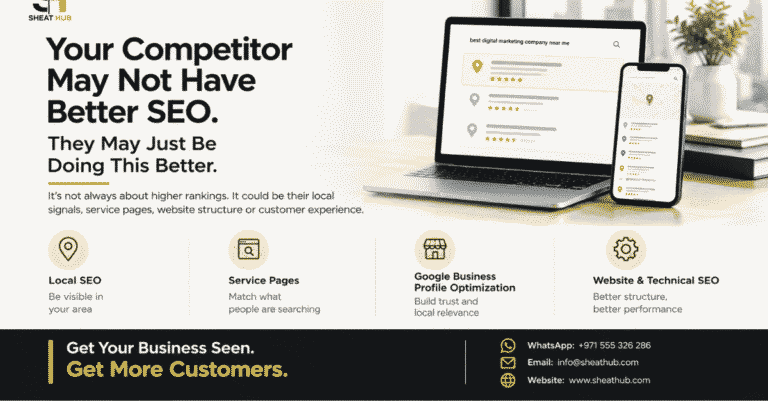
A smaller company may have a much clearer service page, stronger local relevance, better answers to customer questions, and a more useful Google Business Profile.
That can make the difference.
The advantage small businesses often overlook
The biggest opportunity is usually focus.
A large company may target broad terms across many markets. A small business can concentrate on a specific service, customer type, and location.
For example, instead of trying to compete for a broad term such as “digital marketing,” a Dubai business could build useful content around more specific searches related to local SEO, Google Business Profile optimization, technical SEO, or SEO services for a particular industry.
This gives the business a chance to become highly relevant for searches where customer intent is clearer.
Google’s systems work at the page level as well as using broader site signals, which means a smaller website doesn’t automatically prevent an individual page from competing.
Local SEO can level the playing field
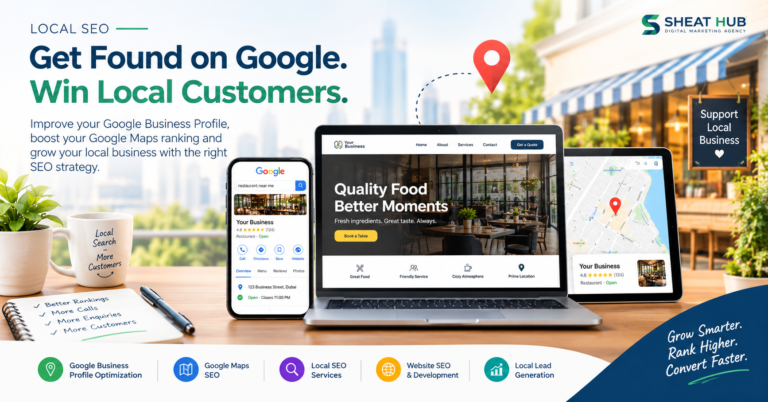
For businesses serving customers in a specific area, Google Maps and local search can be especially important.
Google says local rankings are mainly influenced by relevance, distance, and prominence. Complete business information, reviews, links, and other signals can help Google understand how a business relates to local searches.
This matters in Dubai and across the UAE because customers often search with strong local intent.
They may look for a service near a particular area, search on mobile, compare businesses on Google Maps, or use phrases that include the city or service location.
A small business cannot control distance, but it can improve relevance and build prominence over time.
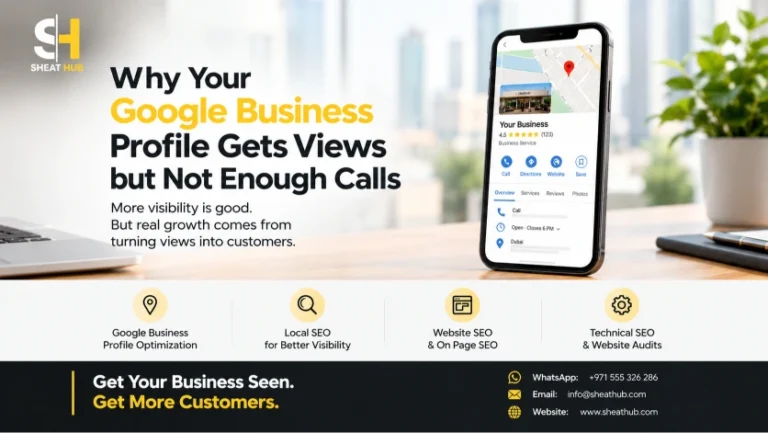
Start by making sure your Google Business Profile accurately reflects what you offer. Use the correct primary category, complete your services and business information, keep contact details consistent, respond to reviews, and add useful photos where appropriate. Google specifically recommends keeping Business Profile information complete and accurate.
Your website may be the real problem
Sometimes a business assumes it needs more backlinks or more blog posts when the bigger problem is its website.
If your homepage tries to explain every service, location, and customer type at once, Google may have difficulty understanding which searches the page should satisfy.
A better structure is usually clearer:
- One page for each important service
- Clear location relevance where genuinely applicable
- Specific page titles and headings
- Useful answers to customer questions
- Strong internal links between related pages
- Clear calls to action
- Fast, mobile-friendly pages
- Accurate business information
Google’s SEO guidance emphasizes making content easy for search engines to crawl, understand, and connect with users. It also recommends clear titles and useful page descriptions.
Don’t try to beat big competitors at everything
This is one of the most common mistakes.
A small business doesn’t need to rank first for every keyword. It needs to identify searches that are commercially useful and realistically aligned with its expertise and service area.
Start with three groups:
High-intent searches:
People looking for a service now.
Problem-based searches:
People trying to understand or solve a problem.
Local searches:
People looking for a provider in a specific area.
Then connect them.
A service page can target high-intent searches. Supporting articles can answer related questions. Your Google Business Profile can strengthen local visibility. Internal links can help users and search engines move between these resources.
The goal is not to publish the most content. It is to build the most useful path from search question to business solution.
What should a small business do first?
If your website isn’t competing well, don’t change everything at once.
Use this process:
1. Check what already ranks
Search for your main services and local variations. Look at the types of pages Google is showing. Are they service pages, guides, directories, local businesses, or something else?
2. Find the gap
Compare the best results with your page. Does your page answer the same questions? Is it more specific? Is the service clearly explained? Is the location clear?
3. Improve the important pages
Start with pages closest to generating enquiries. Improve their headings, content, internal links, calls to action, images, and technical performance.
4. Strengthen local signals
Review your Google Business Profile, business information, categories, services, reviews, and local relevance.
5. Build useful supporting content
Answer genuine questions customers ask before buying. Avoid creating dozens of thin pages simply because a keyword tool suggests them.
6. Measure the right things
Track impressions, clicks, rankings for important queries, Google Business Profile visibility where available, organic enquiries, calls, form submissions, and other meaningful conversions.
Google notes that SEO changes can take time to show an effect, and some changes may take weeks or longer to assess properly.
What small businesses should avoid
Trying to outrank large competitors becomes harder when SEO work is based on shortcuts.
Avoid keyword stuffing, copied content, vague service pages, fake reviews, low-quality links, duplicate location pages, and publishing content purely to attract search traffic.
Google’s current guidance emphasizes people-first content that provides useful, reliable information rather than content created mainly to manipulate rankings.
Don’t assume that adding the same city name to every paragraph will make a page local. Real local relevance comes from accurately explaining the service, area, customer needs, and business offering.
So, can a small business really outrank bigger competitors?
Yes, but the smarter goal is not to beat a large company everywhere.
The opportunity is to become the better result for specific searches.
A small business can compete by being more focused, more locally relevant, more useful, easier to understand, and better aligned with customer intent.
In Dubai and the wider UAE market, that can mean combining a well-structured website with strong local SEO, an accurate Google Business Profile, useful service content, and a clear measurement process.
You don’t need the biggest website.
You need the right pages for the right searches, supported by a business presence Google and customers can understand.
SHEAT HUB Services
SHEAT HUB helps businesses address the SEO problems that can prevent them from competing effectively in search.
Relevant services include Local SEO, Google Business Profile optimization, On Page SEO, Technical SEO, WordPress development, website and SEO audits, and support for Google rankings, AEO, GEO, and AI search visibility.
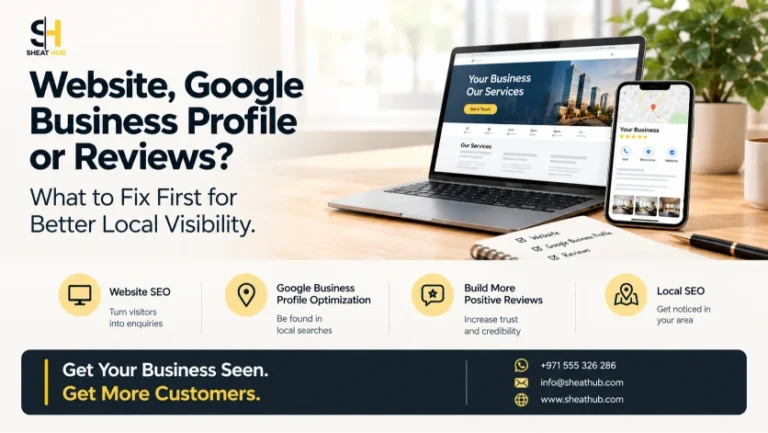
The right starting point depends on the problem. If your website has technical issues, fixing them may come first. If your local presence is weak, Google Business Profile and local SEO may deserve priority. If your pages aren’t matching search intent, on-page improvements may have a bigger role.
FAQs
Can a small business really outrank bigger competitors on Google?
Yes. Google doesn’t rank websites simply according to company size. Relevance, usefulness, expertise, location, usability, and other signals all matter. A small business can compete by focusing on specific services, customer needs, and locations where its pages provide a strong answer to the search.
How long does it take for a small business to improve Google rankings?
There is no fixed timeline. Google explains that some SEO changes can be reflected within hours, while others can take several months. A practical approach is to make improvements, allow enough time for Google to process them, and then evaluate impressions, clicks, rankings, and enquiries before making further changes.
Is local SEO more important for a small business?
It can be especially valuable when customers search for services in a particular area. Google says local results are mainly influenced by relevance, distance, and prominence. Improving your business information, local relevance, reviews, and overall online presence can help Google better understand your business.
Should a small business create lots of blog posts?
Not necessarily. More content isn’t automatically better. Start with pages that support important services and answer real customer questions. Content should provide useful information and demonstrate genuine knowledge rather than being created mainly to insert keywords or increase page count.
Can a small business outrank a large company in Dubai?
It can compete for relevant searches in Dubai when its pages and local business presence closely match what customers are looking for. Location is one of the factors Google considers, while local rankings also involve relevance and prominence. The strongest opportunities depend on the specific service, competition, and search intent.
Do I need backlinks to compete with bigger businesses?
Links can contribute to how Google understands and evaluates pages, but they aren’t the only consideration. A small business should first make sure its website has useful content, strong service pages, good technical foundations, and clear local information. Links should support a good website rather than replace one.
Should I target broad keywords or specific searches?
Specific searches are often a better starting point for smaller businesses because they can have clearer intent and stronger relevance to a particular service or location. Once your important pages are performing well, you can expand your content and keyword coverage based on actual search data and customer needs.
Contact
If you’re a small business struggling to compete with larger companies on Google, start by finding out where the gap actually is.
Email info@sheathub.com or WhatsApp/Call +971 555 326 286 to discuss your website, local SEO, or Google visibility.
#SmallBusinessSEO #LocalSEO #GoogleRanking #DubaiBusiness #UAEBusiness #SEOForSmallBusiness #SHEATHUB