
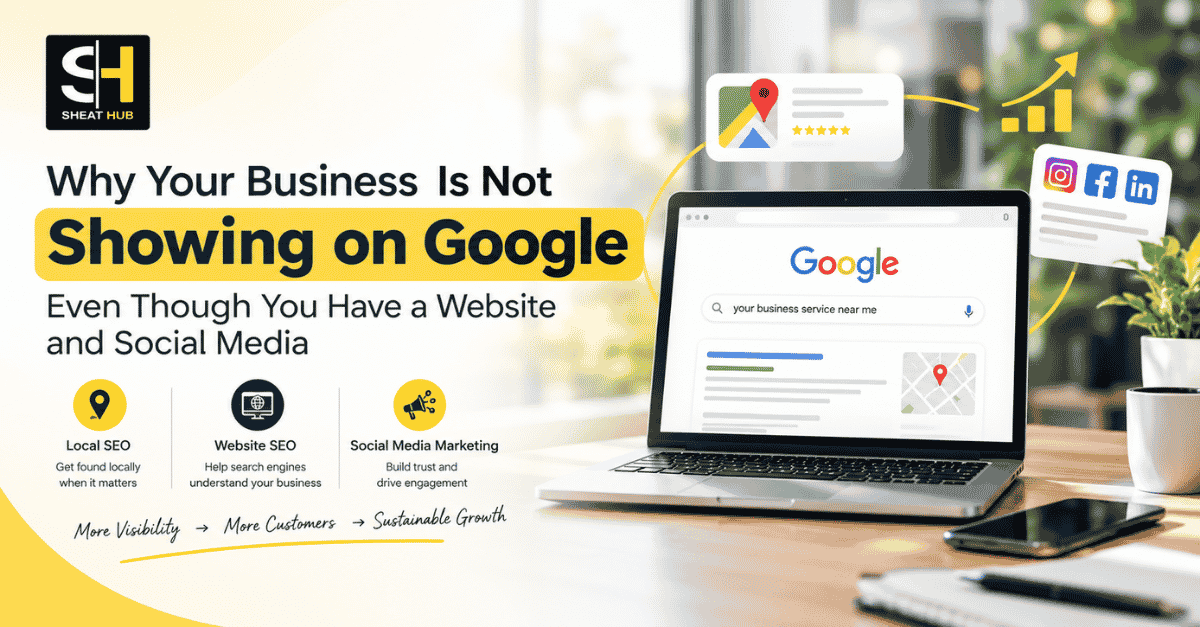
Why Your Business Is Not Showing on Google Even Though You Have a Website and Social Media
You have a website. You post on Instagram and Facebook. You may even have a Google Business Profile. Yet when potential customers search for your service, your business is nowhere near the results.
That can be frustrating, especially when you know people are searching for what you offer.
The problem is that having a website and social media accounts doesn’t automatically make your business visible on Google. Google needs enough useful, consistent and relevant information to understand what your business does, where it operates and which searches it should appear for.
For local businesses, this involves more than one channel. Your Local SEO, website SEO and social media marketing need to support each other. When one area is weak, you can lose visibility, website visits, enquiries and customers to businesses that have built a stronger online presence.
Why isn’t my business showing on Google?
There are several possible reasons.
Your website may not be properly optimized for the services you provide. Your Google Business Profile may be incomplete or poorly aligned with your target searches. Your website may lack location-specific information. Your social media may generate attention but provide little supporting information about your business.
Google says local results are mainly influenced by relevance, distance and prominence. Complete and accurate Business Profile information helps Google understand how relevant your business is to a search.
So the question isn’t simply, “Do I have a website?”
The better question is:
Can Google clearly understand my business, and can customers easily trust and contact me?
1. Your website may not be optimized for what customers search
A website can look professional and still have weak SEO.
For example, a company may have a homepage that says it provides “quality solutions” but doesn’t clearly explain its specific services, locations or customer problems.
Search engines need clear information.
Your important pages should explain:
- What service you provide
- Who the service is for
- Which areas you serve
- What problems you solve
- Why customers should consider your business
- How customers can contact you
Each important service should have useful, dedicated content rather than placing every service on one generic page.
Technical SEO also matters. Problems with indexing, page structure, internal links, mobile usability, metadata or site performance can make it harder for search engines and users to understand and use your website.
2. Your Google Business Profile may be incomplete
For local businesses, Google Business Profile is an important part of the visibility equation.
Google recommends keeping business information complete and accurate. This includes core information such as your business details, hours and contact information.
Check whether your profile has:
- The correct business category
- Accurate contact information
- Correct opening hours
- Relevant services or products where applicable
- A useful business description
- Recent, genuine photos
- Customer reviews and professional responses
- A working website link
But don’t treat your profile as a standalone listing.
Your Google Business Profile, website and other online information should describe the same business consistently.
Google also obtains business information from websites, public information, third parties and user contributions.
That means your wider online presence can help Google build a clearer picture of your business.
3. Your social media presence may not support search visibility
Posting regularly on social media is useful, but social media activity alone isn’t a replacement for SEO.
A business might publish excellent Instagram content but have an outdated website, weak service pages and an incomplete Google Business Profile.
The result is a disconnected online presence.
Instead, use your channels together.
For example:
Website: Publish a detailed service page.
Google: Optimize your Business Profile and connect customers to the relevant page.
Social media: Create educational posts, videos or customer-focused content around the same service.
This creates a stronger path from discovery to research to contact.
Social media can also help demonstrate expertise, customer experiences, services and brand activity. Those signals can support trust when someone discovers your business through Google.
4. Your local relevance may be too weak
If you serve customers in specific cities, districts or service areas, your website should make that clear naturally.
This doesn’t mean repeating a city name dozens of times.
Instead, create useful local content that explains where you work and what customers in those areas actually need.
For example, a service business could have:
- Clear service areas
- Location-relevant service pages where genuinely useful
- Local customer questions and answers
- Relevant project or service examples
- Accurate contact and business information
The goal is to make your location and services understandable to both customers and search engines.
Remember that distance is also part of Google’s local ranking system. You cannot simply optimize your website and expect to appear equally for every location.
5. Your business may lack enough online prominence
Even when Google understands what your business does, it still has to determine how prominent it is compared with other relevant businesses.
Google explains that prominence can be influenced by information it finds across the web, including links and reviews.
This is where reputation and consistent digital marketing become important.
Ask yourself:
- Are customers leaving genuine reviews?
- Is your business mentioned on relevant websites?
- Is your website publishing useful information?
- Are other websites linking to or referencing your business?
- Does your online presence demonstrate real expertise?
- Are your Google, website and social profiles consistent?
You don’t need shortcuts or fake signals. You need a credible online presence that grows over time.
6. Your content may be written for search engines instead of customers
Publishing many articles doesn’t automatically improve visibility.
Google’s guidance emphasizes people-first content that is useful, original, accurate and created to genuinely help the intended audience.
Instead of publishing articles simply because you want to target keywords, answer questions your customers actually ask.
For example:
Weak topic: “Best SEO Services”
Better topic: “Why Your Local Business Website Isn’t Generating Enquiries From Google”
The second topic addresses an actual business problem.
Useful content can also support AEO, GEO, AI search visibility and LLM-based discovery, because clear answers, strong entity information and well-structured content make it easier for search systems to understand your business and expertise.
A practical Google visibility checklist
Before assuming that Google is ignoring your business, check these areas:
- Google Business Profile: Is it verified, complete and accurate?
- Website: Can Google clearly understand your services and locations?
- Service pages: Does each important service have useful, focused content?
- Technical SEO: Can your important pages be crawled and indexed?
- Mobile experience: Is the website easy to use on a phone?
- Reviews: Are you building genuine customer feedback?
- Local relevance: Is it clear where you serve customers?
- Social media: Does your content support your services and website?
- Content: Are you answering real customer questions?
- Conversion: Can visitors quickly call, message, request a quote or contact you?
LocalBusiness structured data can also help search engines understand details about an eligible local business, although structured data doesn’t guarantee enhanced search features.
When should you get an SEO audit?
If you’ve already built a website and social media presence but you’re still receiving very little visibility or few enquiries, guessing may waste more time.
A proper audit can look at your Local SEO, Google Business Profile, website SEO, technical SEO, on-page SEO, content, local relevance, social media alignment and conversion paths together.
At SHEAT HUB, we help businesses identify the gaps between having an online presence and actually being discoverable by potential customers.
The objective isn’t to promise a guaranteed ranking. It’s to understand what is preventing your business from being found, trusted and contacted, then build a practical strategy around those problems.
Your website and social media should work together
Your website, Google presence and social media shouldn’t operate as separate marketing activities.
Your website should explain your services and convert visitors.
Your Local SEO should help customers discover your business when they search for relevant services.
Your social media should reinforce your expertise, demonstrate your services and give potential customers more reasons to trust your business.
When these areas work together, your online presence becomes much easier for customers to understand.
If you’re not sure why your business isn’t appearing on Google, SHEAT HUB can review your current online presence and identify the main SEO, Local SEO and website issues affecting your visibility.
For help with Local SEO, Website SEO, Google Business Profile optimization, Technical SEO, AEO, GEO and AI search visibility, visit SHEAT HUB or contact info@sheathub.com.
You can also call or WhatsApp +971 555 326 286 to discuss your business’s online visibility.
Frequently Asked Questions
Why doesn’t my website appear on Google?
Having a website doesn’t guarantee search visibility. Your site may have indexing, technical SEO, content, relevance or authority issues. Google needs to understand your pages and determine whether they provide a useful match for particular searches.
Why isn’t my business showing on Google Maps?
Your Google Business Profile may be incomplete, unverified, inaccurate or poorly aligned with relevant searches. Local visibility is influenced mainly by relevance, distance and prominence, so optimizing the profile is only one part of the process.
Does social media improve Google rankings?
Social media should not be treated as a direct replacement for SEO. However, an active social presence can support brand awareness, trust and customer discovery while your website and Local SEO focus on search visibility and conversions.
How long does SEO take to improve visibility?
There is no universal timeline. It depends on the website’s condition, competition, search intent, local market, existing authority and the work required. SEO should be measured through visibility, relevant traffic, enquiries and other meaningful business outcomes rather than promises of a fixed ranking.
Should I focus on my website or Google Business Profile first?
For a local business, both matter. Your Google Business Profile supports local discovery, while your website gives Google and customers more information about your services and business. A coordinated strategy is usually more useful than treating either one in isolation.
Can SEO help if my competitors are already ranking?
Yes, but the right approach is to identify why they are more visible and where your business has gaps. An audit can reveal issues involving local relevance, website structure, content, technical SEO, reviews, authority and conversion.
Does my business need AEO, GEO and AI search optimization?
If customers are increasingly discovering businesses through answer-based search and AI-powered search experiences, it makes sense to prepare your website content and business information accordingly. Clear answers, structured information and strong topical relevance can support broader search visibility.