

Why Your Business Has a Website but Still Doesn’t Get Leads
You have a business website. Your services are listed, your phone number is visible, and your website may even look professional. Yet the enquiries aren’t coming.
This is a common problem. A website can be online without actually helping your business attract or convert customers. If your pages don’t appear when people search, load slowly, fail to build trust, or make visitors work to understand what you offer, potential customers can leave before contacting you.
The real issue isn’t simply having a website. Your website needs to be visible, useful, trustworthy, and easy to act on.
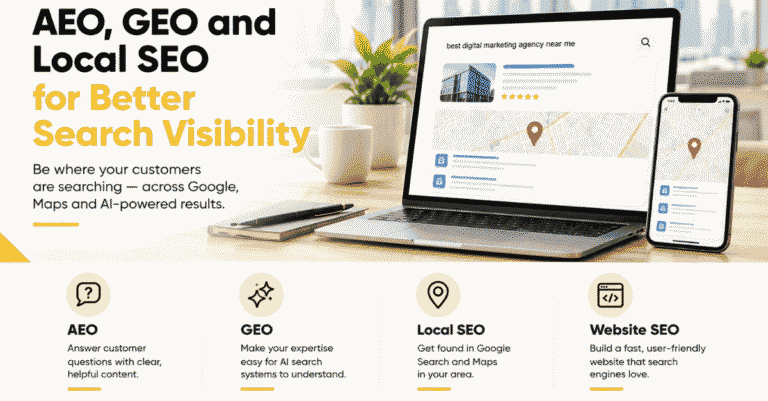
This is where SEO, Local SEO, Google Business Profile optimization, AI Overview SEO, AEO, GEO, and LLM visibility become important.
Your Website May Not Be Reaching the Right People
The first question is simple: Can your potential customers find your website when they search for your service?
A website can look excellent and still receive very little organic traffic if its pages aren’t optimized for relevant searches.
For example, a company offering air conditioning services may have a page called “Our Services”. That tells the visitor very little about what the page should rank for.
A stronger structure could include specific pages targeting searches such as:
- AC repair services
- AC installation
- AC maintenance
- Emergency AC repair
- Commercial AC services
- AC repair near me
Your Website SEO should connect your services with the actual problems and questions your customers search for.
Traffic Alone Doesn’t Guarantee Leads
Getting visitors is useful, but traffic isn’t the final goal.
Someone may find your website through Google and still leave because they can’t quickly answer:
- What exactly does this business provide?
- Do they serve my area?
- Why should I contact them?
- How can I request a quote?
- Can I call or WhatsApp them?
- Does this business appear trustworthy?
This is where On Page SEO and conversion-focused website content work together.
Your headline should explain what you do. Your service pages should explain the problem you solve. Your calls to action should make the next step obvious.
Instead of a vague button such as “Learn More”, consider actions that match buying intent, such as “Request a Quote”, “Book a Consultation”, or “Call Now”, when appropriate for the business.
Poor Local SEO Can Cost You Nearby Customers
If you serve customers in a specific city or service area, appearing in general search results isn’t enough.
People often search with local intent, including phrases such as “near me”, service plus city, or service plus neighbourhood.
Your Google Business Profile is an important part of local visibility. Business information should be accurate and consistent, including your business name, category, contact details, website, services, hours, and service area where applicable.
Your website should also make your service locations clear without creating dozens of thin pages that add little value.
For local businesses, the connection between your website, Google Business Profile, Local SEO, reviews, service pages, and customer experience matters.
Your Website May Be Difficult to Use on Mobile
Many customers will encounter your business through a phone search.
If the website is difficult to navigate on a small screen, important information is hidden, forms are frustrating, or contact buttons are difficult to find, visitors may simply move to another business.
Check your website on an actual mobile device.
Look at:
- How quickly the main page loads.
- Whether the headline is immediately understandable.
- Whether your phone and enquiry options are easy to find.
- Whether forms work correctly.
- Whether text and buttons are comfortable to use.
- Whether important service information appears without excessive scrolling.
Technical SEO also matters because website performance, crawlability, indexing, internal links, page structure, and other technical factors can affect how search engines understand and access your site.
Your Content May Not Answer Customer Questions
Many business websites focus heavily on the company and not enough on the customer.
A potential buyer may have questions about pricing, process, timing, service areas, materials, maintenance, suitability, or what happens after contacting the company.
Useful content can answer these questions before the customer calls.
This also supports AEO, or Answer Engine Optimization. Clear question-and-answer content can make important information easier for search systems and answer engines to understand.
The same principle applies to AI Overview SEO. Search engines increasingly provide direct answers alongside traditional results, so your content needs to clearly explain services, entities, locations, processes, and customer questions.
Your Website Needs to Be Understandable to Search and AI Systems
Search visibility is no longer limited to traditional blue links.
Businesses should consider how their information is understood across Google Search, AI-generated answers, maps, and other discovery systems.
This is where GEO, Generative Engine Optimization, and LLM visibility become relevant.
Your business information should be clear and consistent. Your service pages should describe what you actually do. Important questions should receive direct answers. Relevant entities, locations, services, and business information should be presented naturally.
This doesn’t mean writing content for machines instead of people. It means making your content clear enough for both.
Common Website Mistakes That Reduce Enquiries
Some problems are surprisingly simple:
- One generic page for every service.
- Weak or missing calls to action.
- No clear service areas.
- Slow or poorly structured pages.
- Duplicate or thin content.
- Missing title tags and useful meta descriptions.
- Poor internal linking.
- No useful FAQ content.
- Confusing navigation.
- Contact forms that don’t work properly.
- Outdated business information.
- No clear evidence of experience or expertise.
Fixing these issues doesn’t automatically guarantee leads, but it can remove barriers that stop potential customers from taking the next step.
What Should You Do If Your Website Gets Visitors but No Leads?
Start with an audit rather than immediately redesigning everything.
Review these areas:
Visibility: Are your important service pages appearing for relevant searches?
Intent: Does each page match what the visitor wants to know or do?
Conversion: Is there a clear next action?
Local presence: Is your Google Business Profile connected with your website and local strategy?
Technical health: Can search engines crawl, index, and understand your pages?
Mobile experience: Can someone easily contact you from a phone?
Trust: Does the website provide enough information for someone to feel comfortable making an enquiry?
AI search visibility: Is your content structured clearly enough to answer common questions and explain your services?
A professional website and SEO audit can help identify which problems need attention first.
How SHEAT HUB Can Help Your Website Generate More Opportunities
SHEAT HUB works on the parts of digital visibility that connect search discovery with your website.
Depending on your business needs, this can include Local SEO, Google Business Profile optimization, Website SEO, Technical SEO, On Page SEO, WordPress development, website and SEO audits, Google rankings support, AEO, GEO, and AI search visibility.
The focus should not be adding more pages simply for the sake of having more content. The goal is to make your website easier to find, understand, trust, and use.
If your website is getting traffic but very few enquiries, an audit can help identify where visitors are dropping out and which SEO or website improvements deserve attention first.
For more information, visit https://sheathub.com, email info@sheathub.com, or contact SHEAT HUB on +971 555 326 286.
FAQs
Why does my website get visitors but no leads?
Your website may attract visitors who aren’t ready to buy, or the pages may fail to build trust and guide visitors toward an enquiry. Review search intent, service page quality, calls to action, mobile usability, page speed, contact options, and whether your content answers the questions customers have before contacting you.
Does SEO help a website generate more leads?
SEO can help your business become more visible for relevant searches, but visibility alone doesn’t create enquiries. Your website also needs useful service pages, clear messaging, strong calls to action, good usability, and information that matches customer intent.
Why isn’t my business website appearing on Google?
Possible reasons include weak or missing SEO, poor technical setup, insufficiently useful content, indexing problems, weak local signals, or strong competition for the searches you’re targeting. A technical and SEO audit can help identify the specific issue instead of relying on guesswork.
How does Local SEO help businesses get enquiries?
Local SEO helps businesses become more visible when people search for relevant services in a particular area. It involves factors such as your Google Business Profile, website content, local relevance, business information, reviews, and technical SEO. The aim is to connect your business with relevant local search intent.
What is AI Overview SEO?
AI Overview SEO focuses on making useful, accurate website information easier for search systems to understand and use when generating answers. Clear service explanations, direct answers, strong supporting content, and consistent business information can help your website communicate its expertise and relevance.
Do I need AEO, GEO, and LLM optimization?
These approaches can be useful if customers discover businesses through search engines and AI-powered answer systems. AEO focuses on answering questions clearly, GEO focuses on visibility in generative search experiences, and LLM visibility concerns how clearly your business and its information can be understood by large language model based systems.
Should I redesign my website to get more leads?
Not necessarily. A redesign may be useful when the existing website has serious usability or technical problems, but many businesses first need better SEO, content, conversion paths, mobile usability, or technical fixes. An audit can help determine whether improvements or a full redesign make more sense.
How can I improve my website if I have a limited budget?
Start with the problems most likely to affect visibility and enquiries. Improve your main service pages, fix technical SEO issues, make contact options obvious, improve mobile usability, update your Google Business Profile, and create useful answers to customer questions. Prioritize practical improvements before adding unnecessary features.