
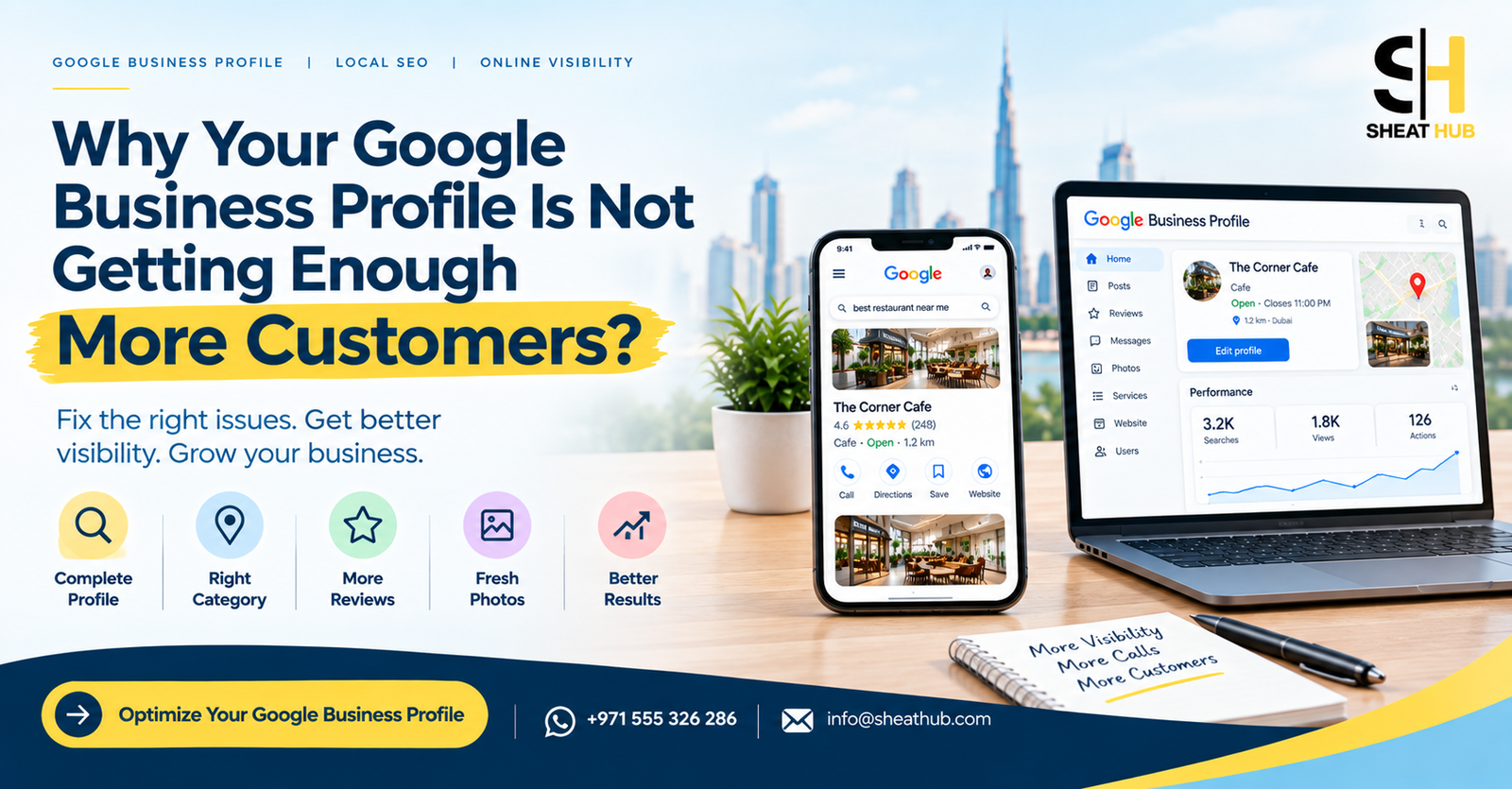
Why Your Google Business Profile Is Not Getting Enough Customers
Having a Google Business Profile is important for any local business, but simply creating one doesn’t guarantee more calls, visits, or enquiries.
A customer searching for your service may see several businesses at the same time. They quickly compare the business name, category, reviews, photos, services, location, website, and other information before deciding where to click.
If your profile is incomplete or poorly maintained, you may be losing customers without even realizing it.
The good news is that many of these problems can be fixed.
1. Your Google Business Profile May Not Be Fully Optimized
A basic profile might have your business name, phone number, and address. But customers often need much more information before they feel comfortable contacting you.
Review the following:
- Primary business category
- Secondary categories
- Business description
- Services
- Opening hours
- Phone number
- Website
- Business location or service area
- Photos
- Customer reviews
Make sure the information is accurate and matches your actual business.
Your Google Business Profile should answer a customer’s basic questions before they need to call you.
2. Choosing the Right Google Business Profile Category
Your primary category is one of the important details Google uses to understand your business.
A common mistake is choosing a category that is too broad simply because it sounds related to the business.
For example, a specialized service provider may benefit from selecting a more specific and accurate category when one is available.
When choosing your category:
- Select the category that best describes your main business.
- Add relevant secondary categories where appropriate.
- Don’t choose unrelated categories just to target more keywords.
- Review your categories if your business services change.
The goal is to give Google a clear understanding of what your business actually does.
3. Your Business Description Should Explain Your Value
Your business description shouldn’t be written only for search engines.
It should also make sense to a real customer.
Explain:
- What your business does
- What services you provide
- Who you serve
- Where you operate
- What makes your business useful
Avoid stuffing the description with repeated keywords.
Instead, write naturally and explain your business clearly.
Good local SEO content should help both Google and customers understand your business.
4. Your Services Should Be Clearly Listed
Many businesses have a list of services on their website but don’t properly reflect those services on their Google Business Profile.
If your profile supports service information, use it properly.
For example, instead of simply writing:
Services
provide useful service names that customers actually understand.
Depending on the business, this could include:
- Emergency AC Repair
- Residential AC Maintenance
- Commercial AC Installation
- AC Cleaning
Clear service information helps customers understand what you offer without having to search through your website.
5. Reviews Can Influence Customer Trust
Let’s be honest.
When customers compare two local businesses, reviews often catch their attention immediately.
A profile with genuine, recent customer feedback can feel more trustworthy than a profile with very few reviews or no recent activity.
But don’t focus only on the number of reviews.
Look at the overall quality of your reputation.
A good review strategy includes:
- Providing a good customer experience.
- Asking genuine customers for honest reviews.
- Responding professionally to reviews.
- Thanking customers for positive feedback.
- Handling negative feedback calmly.
- Looking for common issues mentioned by customers.
Never rely on fake reviews.
Real customer experiences are far more valuable for long-term trust.
6. Don’t Let Your Photos Become Outdated
Your photos can give potential customers a quick idea of what your business looks like and what you offer.
A local business should consider adding relevant photos such as:
- Exterior and storefront
- Interior
- Products
- Completed projects
- Services
- Work environment
- Team or staff, where appropriate
For service businesses, completed work can be especially useful.
A customer may be more confident contacting you after seeing examples of the work you actually provide.
Keep your visual information fresh and relevant.
7. Your Google Business Profile and Website Must Match
Your Google Business Profile and website should tell the same story.
Check that your:
- Business name
- Phone number
- Address
- Services
- Opening hours
- Location information
- Contact details
are accurate and consistent.
More importantly, your website should provide useful information about the services listed on your profile.
For example, if you provide five major services, don’t force every customer to read one generic page.
Create useful service pages where appropriate.
This can support both Local SEO and customer experience.
8. Your Website Needs to Build Trust
A customer may discover your business on Google Maps and then click your website.
That’s your next opportunity to build confidence.
Your website should look professional and answer important questions quickly.
A strong local business website should have:
- Clear service information
- Professional design
- Mobile-friendly pages
- Easy navigation
- Genuine testimonials
- Clear contact details
- Strong calls to action
- Location information
- Fast loading pages
- Useful FAQs
A customer shouldn’t have to hunt around the website to find your phone number or understand what you actually do.
9. Good UI/UX Can Increase Enquiries
SEO can bring people to your website.
But what happens after they arrive?
This is where UI/UX becomes important.
Imagine someone searches for your service, finds your business, visits your website, and then can’t find the contact button.
You may have won the search but lost the customer.
Your website should guide visitors naturally:
Service → Information → Trust → Action
Make important actions easy to find.
Depending on your business, this could be:
Call Now
WhatsApp Us
Request a Quote
Book an Appointment
Get Directions
The simpler the journey, the easier it is for a visitor to become an enquiry.
10. Local SEO Is More Than Google Maps
Google Business Profile optimization is an important part of Local SEO, but it isn’t the entire strategy.
A complete local SEO approach can include:
- Keyword research
- Google Business Profile optimization
- Service page optimization
- Location page optimization
- On-page SEO
- Technical SEO
- Internal linking
- Local content
- Review strategy
- Business information consistency
- Competitor analysis
Your website and Google Business Profile should support each other.
The objective is to build a consistent online presence around your business, services, and target locations.
11. Study the Businesses Ranking Above You
If you’re not getting enough visibility, don’t guess what needs to change.
Look at the businesses appearing above you.
Compare:
Google Business Profile
- Categories
- Reviews
- Photos
- Services
- Profile information
Website
- Page structure
- Service pages
- Location content
- Website speed
- Mobile experience
- CTAs
Customer Experience
- How easy is it to contact them?
- How clearly do they explain their services?
- Do they show genuine reviews?
- Does their website look trustworthy?
You don’t need to copy your competitors.
Instead, identify where your business can provide a better and more useful experience.
A Strong Local SEO Strategy Starts With the Customer
It’s easy to become obsessed with rankings.
But ranking is not the final goal.
A local business needs to move a potential customer through several stages:
Get Found
↓
Get Attention
↓
Build Trust
↓
Answer Questions
↓
Make Contact Easy
↓
Win the Customer
Your Google Business Profile helps with discovery.
Your reviews help build trust.
Your website provides information.
Good UI/UX makes the journey easier.
Clear CTAs encourage action.
That’s how Local SEO becomes more than just a ranking exercise.
What Should You Check Today?
If you own a local business, take a few minutes to review your online presence.
Start with these five questions:
1. Can customers easily find my business on Google Maps?
2. Is my Google Business Profile complete and accurate?
3. Does my website clearly explain my services?
4. Does my website look professional and work well on mobile?
5. Can a customer contact me within a few seconds?
If the answer to any of these is no, you’ve already found an area worth improving.
Final Thoughts
Your Google Business Profile is not just an online listing.
For many local businesses, it’s one of the first places potential customers interact with the brand.
That’s why Google Business Profile optimization, Local SEO, website development, and UI/UX should work together.
Don’t focus only on appearing in search results.
Focus on creating an online presence that makes customers think:
“This business looks trustworthy. They offer what I need. I’ll contact them.”
That is where better local visibility can turn into real business growth.
Need Help With Your Local SEO?
At SHEAT HUB, we help businesses improve their local online presence through:
Local SEO | Google Business Profile Optimization | Website SEO | Website Development | UI/UX
📲 WhatsApp: +971 555 326 286
📧 Email: info@sheathub.com
Get found. Build trust. Get more customers.