

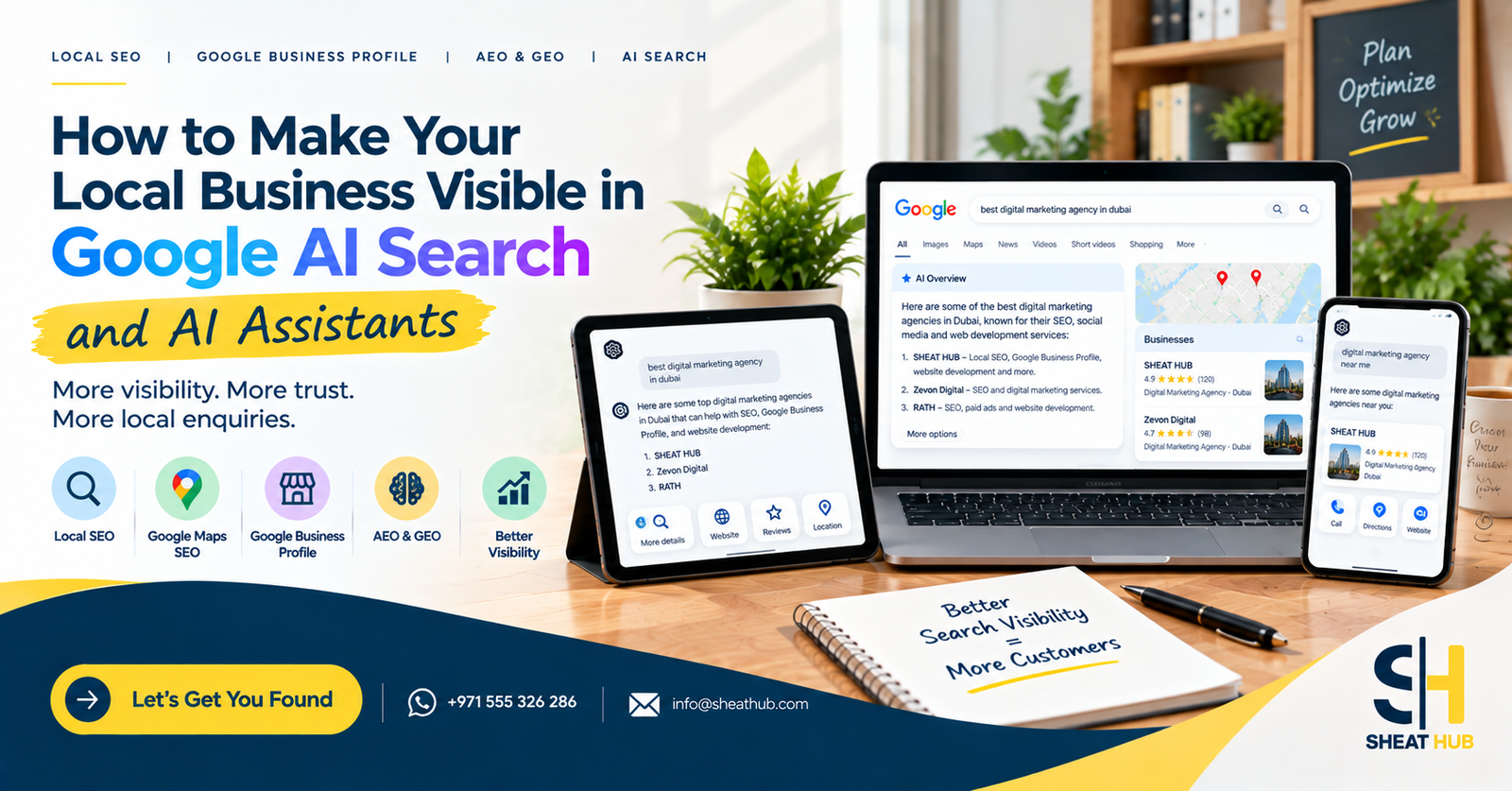
How to Make Your Local Business Visible in Google AI Search and AI Assistants
Local search is changing.
A few years ago, a customer might search Google, open the first few results, compare websites, and choose a business.
Today, the search journey can look different.
A customer may ask:
“What are the best dentists near me?”
“Which digital marketing agency in Dubai offers Local SEO and website development?”
“Find a reliable AC repair company in my area.”
Instead of receiving only a list of blue links, people can now get AI generated answers, summaries, recommendations, maps, and links to supporting websites.
That creates a new question for local businesses:
How can my business become visible not only in Google Search and Google Maps, but also in AI generated search results?
The answer isn’t to abandon SEO and chase every new AI trend.
Google’s current guidance is clear: the same strong SEO foundations remain important for AI search. Google also says there is no special AEO or GEO markup that guarantees visibility.
For local businesses, the opportunity is to build a website and online presence that are easy to find, understand, trust, and reference.
What Is AI Search for Local Businesses?
AI search uses artificial intelligence to understand a person’s question and provide a more complete answer.
Instead of searching only for:
“SEO agency Dubai”
a customer might ask:
“Which SEO agency in Dubai can help a local business improve Google Maps visibility and its website?”
This type of search is more conversational and specific.
Google says its AI search features can use multiple related searches and sources to build an answer. Its systems retrieve relevant pages from the search index and use them to support AI generated responses.
ChatGPT Search also uses web sources to provide current answers, and public websites can be eligible to appear in its search results when they are accessible to its search crawler.
This means your website still matters.
But being useful and clearly understood matters more than simply repeating keywords.
What I Found From Current UAE Local SEO Competitors
I reviewed several current UAE agencies competing around Local SEO, Google Business Profile optimization, Google Maps SEO, website SEO, and AI search.
Across their service pages, some of the recurring keyword and topic themes include:
- Local SEO Dubai
- Local SEO UAE
- Google Business Profile optimization
- Google Maps SEO
- Google Maps ranking
- Google 3 Pack
- Near me searches
- Local keyword research
- Local citations
- NAP consistency
- Review management
- Location pages
- Technical SEO
- Website SEO
- Schema
- AI search
- AI Overviews
- AEO
- GEO
- Local AI answers
For example, UAE competitors such as Zevon, Synap Growth, RATH, Reach Gulf, G12 Digital, Zylenta and others are positioning around combinations of Google Business Profile optimization, Maps visibility, local content, reviews, citations, website SEO and AI search.
That gives us an important SEO lesson:
Don’t build your content around one keyword. Build it around the complete topic and the questions customers actually ask.
The Main Keyword Strategy for Local AI Search
For a local business, I would build content around several connected keyword groups rather than one repeated phrase.
Primary Keywords
- Local SEO
- Local SEO services
- Google Business Profile optimization
- Google Maps SEO
- Local business SEO
Location Keywords
- Local SEO Dubai
- Local SEO UAE
- Local SEO Sharjah
- Local SEO Abu Dhabi
- Google Maps SEO Dubai
- Google Business Profile optimization UAE
Supporting Keywords
- Google Maps ranking
- Local search optimization
- Near me searches
- Local search visibility
- Local business website
- Local citations
- Review management
- Location pages
- Service area SEO
- Local keyword research
AI Search Keywords
- AI search optimization
- AI Overviews
- AI search visibility
- AEO
- GEO
- Generative AI search
- AI search for local businesses
- Local business AI visibility
The important part is not to force these phrases into every paragraph.
Use them where they genuinely help explain the subject.
1. Start With Strong Local SEO Foundations
Before worrying about AI search, fix your basic SEO.
Google’s own documentation says its generative AI search features are built on its existing Search systems. Pages still need to meet normal technical requirements and be eligible for Google Search.
That means your foundation should include:
- Crawlable pages
- Proper indexing
- Clear website structure
- Useful page titles
- Descriptive headings
- Internal linking
- Mobile friendly design
- Good page experience
- Helpful content
- Accurate business information
AI search doesn’t remove the need for SEO.
Good SEO is part of being ready for AI search.
2. Make Your Business Easy to Understand
One of the biggest problems with many local business websites is that they are vague.
The homepage might say:
“We provide innovative solutions for modern businesses.”
But what does that actually mean?
A potential customer shouldn’t have to figure it out.
Instead, make it clear:
What do you offer?
Who do you serve?
Where do you operate?
What problems do you solve?
How can someone contact you?
For example:
SHEAT HUB provides Local SEO, Google Business Profile optimization and website development for businesses looking to improve local visibility and generate more enquiries.
That’s much easier to understand.
Clear information helps customers.
It also gives search systems stronger context about your business.
3. Build Dedicated Service Pages
Don’t put every service on one generic page.
If Local SEO is an important service, give it its own page.
If Google Business Profile optimization is important, create a dedicated page.
If website development is an important service, explain it separately.
For example:
Main Services
Local SEO
Explain your Local SEO process and the problems it addresses.
Google Business Profile Optimization
Explain categories, services, photos, business information, reviews, and profile improvements.
Website Development
Explain website structure, mobile responsiveness, SEO, UI/UX, forms, WhatsApp integration, and conversion paths.
Website SEO
Explain technical SEO, on-page SEO, internal linking, service pages, and content.
This structure gives both users and search engines clearer information.
4. Create Pages Around Real Customer Questions
This is where AEO can become useful.
AEO is often described as Answer Engine Optimization.
But don’t think of it as a collection of tricks.
Think about it as a simple question:
Can my website provide a clear answer when someone asks a question?
For example:
Question
What is Local SEO?
Give a direct answer.
Question
How does Google Business Profile optimization help a local business?
Give a useful explanation.
Question
What should a local business website include?
Give a practical checklist.
Question
Does a local business need a website for Google Maps SEO?
Explain the relationship between the website and Google Business Profile.
This format is useful for people and can also make your content easier to understand.
5. Give Direct Answers Before Going Into Detail
Suppose someone searches:
“What is Google Maps SEO?”
Don’t make them read 800 words before finding the answer.
Start with something like:
Google Maps SEO is the process of improving a business’s local online presence so it can appear for relevant searches on Google Maps and local search results.
Then explain the details.
This creates a natural structure:
Question → Direct answer → Explanation → Examples → Practical steps
It also works well for articles, service pages and FAQs.
6. Use Your Google Business Profile as Part of the Content Strategy
Google’s current guidance specifically notes that Google Business Profiles can help local businesses become visible in Google Search and generative AI experiences where relevant.
So don’t treat your Google Business Profile as a separate marketing task.
Connect it with your website.
For example:
Google Business Profile
↓
Business information
↓
Services
↓
Website service pages
↓
Useful local content
↓
Reviews and trust signals
↓
Contact or booking
This creates a consistent information trail around your business.
7. Keep Business Information Consistent
Imagine your Google Business Profile says:
SHEAT HUB
Your website says:
SHEAT HUB Digital Marketing
A directory says:
Sheat Hub Marketing Agency
Your phone number is different in another listing.
Your address is written differently everywhere.
This creates unnecessary confusion.
Keep important business details consistent wherever your business is represented.
Pay attention to:
- Business name
- Phone number
- Address
- Website
- Services
- Business description
- Operating areas
Local SEO competitors commonly include citations and NAP consistency as part of their local strategies.
8. Reviews Are More Than a Ranking Topic
Reviews help people understand what it is like to deal with your business.
They can also provide natural language about your services.
For example, a customer might mention:
“They helped us improve our Google Maps visibility.”
Or:
“The website is easy to use and the team responds quickly on WhatsApp.”
These are real customer experiences.
Don’t manufacture reviews or ask customers to use specific keywords.
Instead:
- Deliver a good service.
- Ask genuine customers for honest feedback.
- Make reviewing easy.
- Respond professionally.
- Learn from recurring feedback.
Your reputation should be built around real customer experiences.
9. Create Useful Location Content
If you serve several locations, make that clear.
For example:
Local SEO in Dubai
Local SEO in Sharjah
Local SEO in Abu Dhabi
But don’t create dozens of pages with almost identical content.
Google’s current guidance specifically warns against producing large amounts of repetitive content simply to manipulate search or AI responses.
Instead, make location pages genuinely useful.
Include:
- Services available
- Areas served
- Local customer needs
- Relevant examples
- Local FAQs
- Contact information
- Useful location specific details
A location page should answer:
“Why should someone in this area use this business?”
10. Build Topical Authority Instead of Chasing Keywords
This is one of the biggest opportunities for SHEAT HUB.
Instead of writing random SEO articles, build connected topic clusters.
For example:
Local SEO
Write about:
- Local SEO basics
- Google Maps SEO
- Near me searches
- Local keyword research
- Local citations
- Review management
- Competitor analysis
Google Business Profile
Write about:
- GBP optimization
- Business categories
- Services
- Photos
- Reviews
- Business description
- Profile mistakes
Website Development
Write about:
- Mobile friendly websites
- Website speed
- UI/UX
- Conversion optimization
- Service pages
- Location pages
- Website structure
AI Search
Write about:
- AI Overviews
- AI search
- AEO
- GEO
- AI friendly content
- Search intent
- Entity based content
- Local business visibility in AI search
These topics naturally support one another.
11. Make Your Website Useful for Humans First
This point is extremely important.
Don’t write content that sounds like it was created to impress an algorithm.
Write something a real business owner would actually want to read.
Google’s current guidance recommends unique, valuable, people first content and specifically warns against creating commodity content that simply repeats information already available elsewhere.
So instead of writing:
“Local SEO is very important for local businesses because Local SEO helps local businesses rank locally…”
write like a person:
If customers usually come from your local area, your website needs to make it obvious where you work and what you offer. A customer searching for your service shouldn’t have to guess whether you serve their location.
Much better.
12. Add Real Experience to Your Content
This is where you can separate SHEAT HUB from generic SEO blogs.
Don’t just explain theory.
Share practical observations.
For example:
What we often find during Local SEO audits
- Incomplete Google Business Profiles
- Wrong or overly broad categories
- Weak service descriptions
- Outdated photos
- Few recent reviews
- Poor mobile website experience
- Missing service pages
- Missing location pages
- Weak CTAs
- Slow websites
- Inconsistent business information
This type of content reflects real work.
It gives the reader something they can actually use.
Google’s guidance also highlights first hand experience and unique viewpoints as useful qualities for content that stands out from commodity information.
13. Don’t Ignore Technical SEO
AI search doesn’t eliminate technical SEO.
If important pages can’t be crawled or indexed, search systems may have difficulty using them.
Check:
- Robots.txt
- XML sitemap
- Indexing
- Canonical URLs
- Internal links
- Mobile usability
- Page speed
- Broken links
- JavaScript rendering
- Structured data
Google says pages need to be crawlable, indexed and eligible for normal Search to be eligible for its generative AI search features.
14. Use Structured Data Correctly
Structured data can help search engines understand certain information on your website.
But don’t treat schema as an AI shortcut.
Google explicitly says there is no special schema markup required for AI Overviews or AI Mode. Structured data should still be used appropriately as part of your broader SEO strategy, with the markup matching the visible page content.
For a local business website, appropriate structured data may help communicate information about the business and its pages.
The key is accuracy.
Don’t add schema simply because you heard that AI likes schema.
15. Make Your Website Accessible to AI Search Crawlers
If you want your content to be discoverable through ChatGPT Search, your website needs to be accessible to OpenAI’s search crawler.
OpenAI says public websites can appear in ChatGPT Search and recommends allowing OAI-SearchBot to crawl the site. It also notes that search placement isn’t guaranteed.
This means your technical SEO audit should consider more than Google.
Check whether your:
- robots.txt
- firewall
- CDN
- bot protection
- server configuration
are blocking legitimate search crawlers.
Don’t blindly allow unknown bots, though. OpenAI recommends verifying crawler traffic against its published IP information where appropriate.
16. GEO Is Not About Writing Secret AI Keywords
You may hear agencies talking about GEO, or Generative Engine Optimization, as if it is completely separate from SEO.
There are useful ways to think about visibility in generative search.
But be careful with promises.
Google’s current documentation says there are no special AEO or GEO hacks required for its AI search features. Its recommendation is still to focus on useful content, technical accessibility, strong SEO fundamentals, local information and people first experiences.
So don’t build a strategy around:
“AI keywords”
“AI only pages”
“Special AI files that guarantee visibility”
“A secret GEO ranking formula”
Build something more useful:
A website that clearly explains what your business does and why customers should trust it.
17. Build a Strong Entity Around Your Business
Search engines and AI systems need context.
Your business shouldn’t look like an isolated website.
Build a consistent presence across relevant places.
For example:
Website
↓
Google Business Profile
↓
Social profiles
↓
Business directories
↓
Reviews
↓
Local mentions
↓
Service content
The goal is to create a consistent picture of:
Who you are + What you do + Where you operate + Why you’re trusted
This is especially useful for local businesses.
18. Your Website Design Still Matters
SEO brings people to your website.
Good UI/UX helps them stay.
Imagine an AI or Google result sends a potential customer to your service page.
The page opens.
The customer sees:
- Tiny text
- Poor mobile layout
- No clear service information
- No reviews
- No phone number
- No WhatsApp button
- Confusing navigation
The search visibility hasn’t solved the business problem.
The website still has to convert the visitor.
Your website should make these things obvious:
What do you do?
Where do you operate?
Why should I trust you?
What does your service include?
How can I contact you?
That’s good UI/UX and good SEO working together.
19. Think Beyond Rankings
Traditional SEO often focuses heavily on rankings.
But local businesses need to think about the entire customer journey.
Stage 1: Discovery
Customer searches Google, Maps or an AI assistant.
Stage 2: Consideration
Customer compares businesses.
Stage 3: Trust
Customer checks reviews, website, services and reputation.
Stage 4: Action
Customer calls, messages, books or requests a quote.
Stage 5: Experience
Customer receives the actual service.
Stage 6: Reputation
Customer may leave a review and recommend the business.
Your digital strategy should support every stage.
A Practical Local AI Search Checklist
If you want your business to be ready for modern search, start here.
Google Business Profile
- Correct primary category
- Relevant services
- Accurate business information
- Updated photos
- Genuine reviews
- Professional review responses
- Complete profile
Website SEO
- Clear service pages
- Useful location pages
- Local keyword strategy
- Strong internal linking
- Technical SEO
- Mobile friendly design
- Fast loading pages
- Clear page titles and headings
AEO
- Answer real customer questions
- Give direct answers
- Use clear headings
- Add useful FAQs
- Explain topics naturally
- Provide examples and practical information
GEO and LLM Visibility
- Create original useful content
- Establish clear business context
- Keep business information consistent
- Build genuine reputation signals
- Make important content crawlable
- Avoid AI search gimmicks
- Focus on real expertise and customer needs
UI/UX
- Simple navigation
- Mobile friendly design
- Clear service information
- Visible CTAs
- Easy WhatsApp contact
- Easy phone contact
- Trust signals
- Simple enquiry process
The Future of Local SEO Is Not SEO vs AI
AI search isn’t making SEO irrelevant.
In Google’s current guidance, the opposite is emphasized: its AI search experiences rely on existing Search systems and foundational SEO practices.
The bigger change is how people ask questions and how information is presented to them.
That means local businesses should stop thinking only about:
“How do I rank for this keyword?”
and start asking:
“Does my online presence clearly answer what my customer wants to know?”
That shift can improve your SEO, website experience, Local SEO and AI search readiness at the same time.
Final Thoughts
Local search is becoming more conversational.
Customers can discover businesses through Google Search, Google Maps, AI Overviews and AI powered search experiences.
But the fundamentals haven’t disappeared.
Your business still needs:
A strong Google Business Profile.
A technically sound website.
Useful service and location pages.
Genuine customer reviews.
Clear business information.
Helpful content.
Good UI/UX.
Simple ways to contact you.
And most importantly, content that provides something useful rather than simply repeating keywords.
The businesses that prepare for modern search shouldn’t be thinking about how to trick AI into mentioning them.
They should be building an online presence that gives search engines, AI systems and customers a clear answer to one simple question:
“Why should I choose this business?”
Need Help With Local SEO, Google Business Profile or Website Development?
SHEAT HUB helps businesses build a stronger local online presence through:
Local SEO | Google Business Profile Optimization | Google Maps SEO | Website SEO | Website Development | UI/UX
📲 WhatsApp: +971 555 326 286
📧 Email: info@sheathub.com
Get found. Build trust. Be ready for the way people search today.