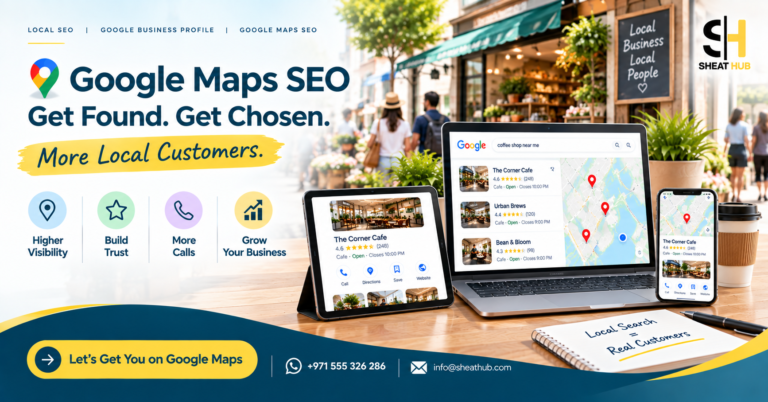


Why Your Competitor Appears on Google Maps, Search, and Local Results While You Don’t
Type your main service and your suburb into Google. There they are again: your competitor at the top of Maps, in the search results and in the local results too, while your business is nowhere to be seen. Your work is just as good. So why does Google keep choosing them?
The honest answer is rarely what business owners expect. It is usually not one big thing your competitor does right, but small signals that tell Google their business is the safer, clearer, more relevant answer. Most are fixable, and none need a bigger budget than your competitor has.
The search is a comparison, not a test
When a customer in Sydney, Melbourne, Brisbane or Perth searches for a service near them, Google is not grading your business alone. It compares you with every similar business nearby and ranks the one that looks most relevant, most trustworthy and closest to what the customer asked for.
Appearing on Maps, in search and in local results at the same time is not luck. It is the result of a business that looks consistent and complete across all three places. If your competitor appears everywhere and you appear nowhere, something in that comparison is working against you, and it is worth finding out what it is before you spend another dollar on advertising.
Reason 1: Their profile tells a clearer story
Start with the Google Business Profile, because that is what customers see first on Maps. A complete profile answers their questions before they ask them: what you offer, where you operate, when you are open, and what other customers say?
Many businesses set up a profile once and forget it: a vague category, an empty services list, a thin description and photos years old. A competitor with a well-chosen category, full services, recent photos and regular posts gives Google more to work with, and the customer more reason to choose them.
Check your own profile the way a customer would. Does it say exactly what you do, in the words customers search for, and list every service you offer? If not, Google has less to match your business against.
Reason 2: Their website backs up their profile
Google cross-checks your profile against your website. When the two match, the business looks real and reliable. When they do not, Google trusts neither one as much.
A common problem is a website that says very little about the services a business sells: a homepage that tries to cover everything, vague service pages, and no pages for the areas you serve. Your competitor may simply have clearer service pages, describing each service and the areas covered.
Your website also needs to work on a phone. Most local searches happen on mobile, and a customer who finds a slow page or a contact form that is hard to use will go straight back to the results and pick the next business.
Reason 3: They look closer to the customer
Distance still matters in local search: a business in the same suburb as the searcher has a natural advantage. But it is not the whole story, and you cannot change it by moving premises.
What you can control is how clearly you define the areas you serve. A business that covers several suburbs but never says so may look as if it only serves its own street. A competitor who lists their service areas clearly, with pages naming the suburbs they work in, looks like the local option for a much wider area. Say so plainly on your profile, your website and your service pages.
Reason 4: They have earned more trust signals
Reviews are the trust signal customers notice first, and Google pays attention too. But it is not simply a numbers game. A business with fewer reviews can still outrank one with more, because what matters is the pattern: recent, detailed reviews that mention the service, and thoughtful replies from the owner.
A competitor who asks happy customers for reviews, replies to every review, and keeps new ones coming looks active and cared for. A business with a handful of old, unanswered reviews and nothing new for months looks quiet, even if the work behind it is excellent. Recent photos of real work show a customer what to expect, while old or missing photos leave them guessing.
Reason 5: They answer the question the customer actually asked
Every local search is a question, even when it is only a few words long. “Emergency plumber near me” asks who can come now. “Best family dentist in Brisbane” asks who they can trust with their children. The business that answers most directly gets the click.
This is where many businesses lose out without realising it. Their website talks about themselves, their history and their values, but never answers the question the customer typed in. Their competitor’s pages answer it in the first few lines and make the next step obvious: call, book, or message on WhatsApp.
Being relevant is not about stuffing pages with keywords. It is about matching the words and the intent behind the search, then making it easy for the customer to act.
What to check first
Start with a search of your own, in the words your customers use, and note where you appear and where your competitor appears. Then check your profile against theirs: category, services, description, photos, posts, reviews and replies. Then check your website the same way: does each service have its own clear page, do your pages mention the areas you serve, and is it easy to contact you from a phone?
Watch for the usual traps as you go: details that differ between your profile and website, one page trying to rank for every service and suburb, and months without an update. Fix the mismatches first: consistency is the cheapest win in local search.
Then look at your reviews: ask recent happy customers, reply to every review you have, and add fresh photos that show real work. Finally, look at the search from the customer’s side. If someone in your area searched for your service today, would your profile and website answer them clearly, and would they know what to do next? If not, that is where the work belongs.
Local search in Australia
Australian customers search like customers everywhere, but the geography is different. Suburbs matter: customers often search with a suburb name rather than a city name, so a business that only mentions the wider city can miss the searches happening closest to home.
Mobile matters too. Australians search on the move, often while standing in front of the problem: a leaking tap, a broken air conditioner. If your profile and website make it easy to call or message straight from a phone, you will win customers your competitor’s slower pages lose.
How SHEAT HUB Can Help
If your competitor keeps appearing on Google Maps, Search and local results while you do not, the fix starts with finding out exactly where the gap is. SHEAT HUB compares your Google Business Profile, website and local presence with your competitors, and shows you which signals are holding you back.
That work covers Local SEO and Google Business Profile Optimization, including categories, services, photos, posts and reviews, and Website SEO, from On-Page and Technical SEO Audits to clearer service and location pages. Answer Engine Optimization helps your business appear in AI overviews and assistants too, not just in the old list of links.
The aim is simple: when a customer in your area searches for what you do, your business should be the one they see, trust and contact.
Frequently Asked Questions
Why does my competitor appear on Google Maps but I do not?
Your competitor’s profile is probably more complete and more consistent with their website. Google shows businesses whose category, services, service areas, photos and reviews give it a clear picture of what they do and where they do it. If your profile is thin, outdated or inconsistent with your website, Google has less to match against a local search, so it shows the business it understands better.
Can a business with fewer reviews outrank one with more?
Yes, and it happens often. Reviews are only one signal among many. A business with fewer but recent, detailed reviews, thoughtful replies and a complete profile can outrank a business with more reviews that are old, unanswered, or sitting on a thin profile. Recency, relevance and replies matter as much as the total count, and a stronger website can tip the balance further.
Does my website really affect my Google Maps ranking?
Yes. Google cross-checks your profile against your website, and when the two tell the same story, your business looks more reliable. Clear service pages, pages that mention the areas you serve, and a fast mobile-friendly site all support your Maps visibility. A website that contradicts your profile, or says almost nothing about your services, weakens the whole picture.
How long does it take to catch up with a competitor on Google?
There is no fixed timeline, and anyone who promises one is guessing. Fixing a profile, aligning a website and earning fresh reviews can improve visibility over weeks, but catching a well-established competitor usually takes consistent work over months. The businesses that catch up are the ones that fix the basics first, then keep their profile, website and reviews active and up to date.
Should I copy what my competitor is doing?
Learn from them, but do not copy them. Look at what their profile, website and reviews do well, then do it better in your own words and with your own proof. Copying their text or claiming services you do not offer will hurt trust and can create problems with Google. Your own complete profile, clear service pages and genuine reviews are worth more than a copy of someone else’s.
What is the first thing I should fix if I am invisible locally?
Start with consistency and completeness. Make sure your business name, phone number, services and areas are identical on your profile and your website, then fill in everything your profile is missing: services, description, photos and posts. That single round of fixes gives Google the clearest possible picture of your business, and it is the foundation everything else builds on.
Get in Touch
Website: https://sheathub.com
Email: info@sheathub.com
WhatsApp Call: +971 555 326 286