
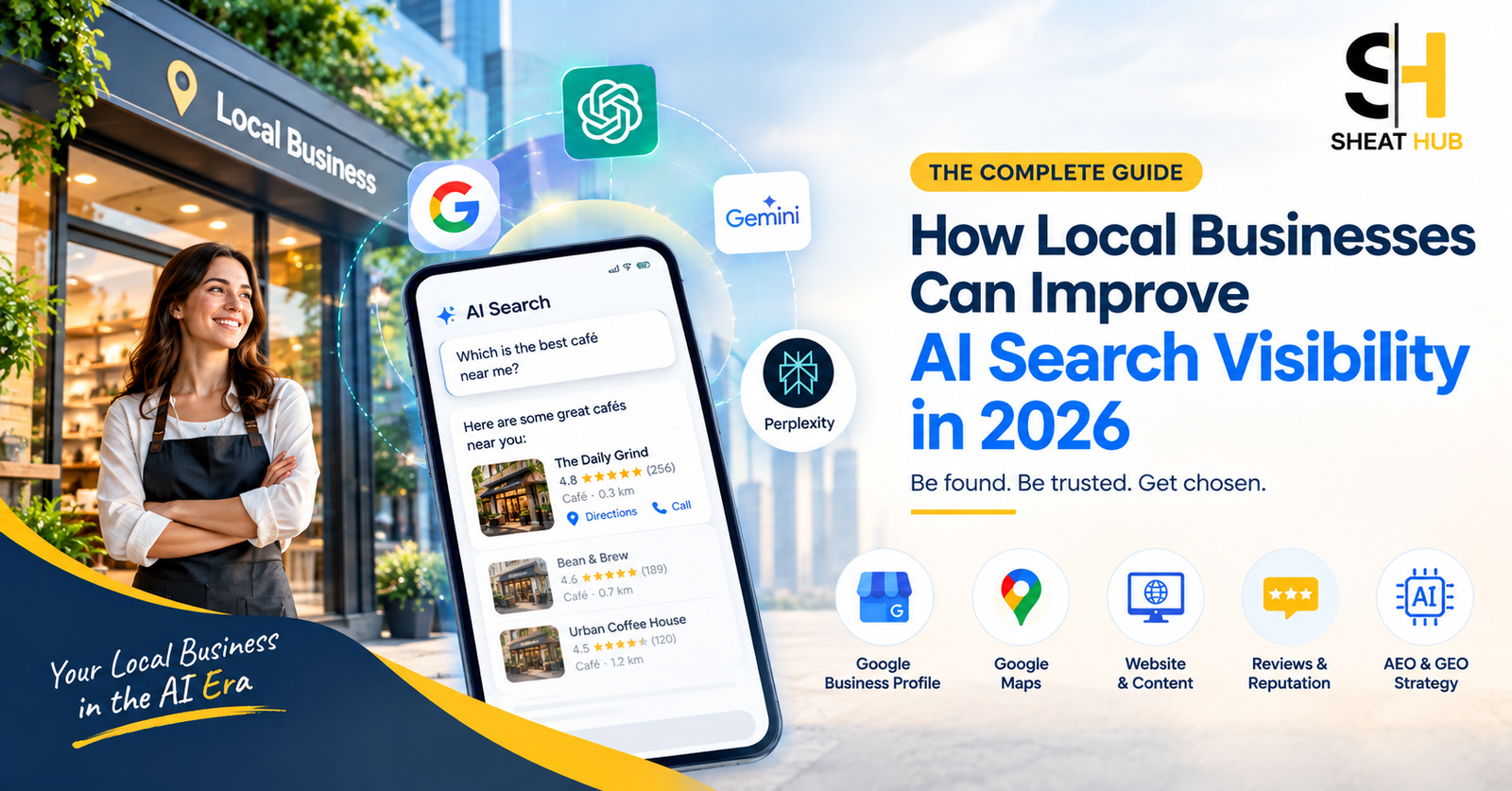
How Local Businesses Can Improve AI Search Visibility in 2026
Local search is entering a new phase.
For years, local businesses focused on appearing in Google Search and Google Maps. Today, customers are also asking AI platforms questions such as:
- Who is the best dentist near me?
- Which AC company serves my area?
- What are the best restaurants in Dubai?
- Who can build a villa in Sharjah?
- Which lawyer should I contact in Melbourne?
- Can you recommend a reliable cleaning company nearby?
Instead of receiving a traditional list of search results, users may receive an AI generated answer containing a small selection of businesses.
This creates a new challenge for local businesses:
How do you make your business easy for AI systems to discover, understand and accurately represent?
This is where AI search optimization, Local SEO, AEO and GEO are becoming increasingly relevant.
Recent research into 200,000 local AI searches found that businesses appearing prominently in Google Maps were not automatically prominent across AI search platforms. The research also found that business websites were a major source of the information used by AI systems.
What Is AI Search Visibility?
AI search visibility refers to how often and how accurately a business appears in AI powered search and recommendation experiences.
These can include:
- ChatGPT
- Google AI Overviews
- Google AI Mode
- Gemini
- Perplexity
- Other AI powered search experiences
For example, imagine someone searches:
“Who provides emergency AC repair in Dubai?”
An AI system may look at publicly available information and generate an answer containing several local businesses.
If your business isn’t clearly represented in the information available to the system, it may not appear in that answer.
This doesn’t mean traditional SEO has become irrelevant.
Instead, local businesses now have another search environment to consider.
Why AI Search Matters for Local Businesses
Google remains a major source of local discovery. Research published by BrightLocal in July 2026 found that 84% of consumers surveyed had searched for a local business online in the previous three months, while three quarters had used more than one channel during their most recent local business search.
At the same time, AI is becoming part of the research process.
This creates a broader customer journey:
Google Search → Google Maps → Website → Reviews → AI Search → Business
Or it can happen in another order.
A customer might start by asking an AI assistant for recommendations, then check Google Maps and reviews before contacting the business.
The important point is that customers don’t necessarily use only one platform.
Local SEO and AI Search Are Connected
AI search optimization shouldn’t be treated as a replacement for Local SEO.
Your traditional local search foundation still matters.
That includes:
- Google Business Profile
- Google Maps
- Business website
- Customer reviews
- Local citations
- Service pages
- Location pages
- Local content
- Technical SEO
- Clear business information
Google states that local results are mainly influenced by relevance, distance and prominence. Google also recommends keeping Business Profile information complete and accurate, responding to reviews and adding photos and videos.
AI search adds another layer to this process.
Your business information needs to be clear enough for both customers and machines to understand.
How AI Systems Can Understand a Local Business
There isn’t a single public formula that guarantees an AI platform will mention a particular business.
However, an AI system needs accessible information to understand basic facts about a business.
That can include:
- Business name
- Services
- Location
- Service areas
- Opening hours
- Website
- Customer reviews
- Business categories
- Industry information
- Credentials
- Contact details
- Third party mentions
- Relevant content
This is why consistency matters.
If your website says one thing, your Google Business Profile says something different and other directories contain outdated information, the overall picture becomes less clear.
Your Website May Be More Important Than You Think
One of the most interesting findings from recent local AI search research is the role of business websites.
BrightLocal’s September 2026 study of 200,000 local AI searches found that 93% of unique domains used as sources were business websites, accounting for 42% of all citations in the study.
This gives local businesses a practical reason to take their websites seriously.
Your website shouldn’t simply contain:
Home | About | Services | Contact
It should clearly explain what your business does and the customers and locations it serves.
Create Clear Service Pages
A common local SEO mistake is placing every service on one page.
For example, a digital marketing agency may offer:
- Local SEO
- Google Business Profile optimization
- Website development
- Technical SEO
- Social media management
- Google Ads
Instead of placing everything into one long services page, important services can have dedicated pages.
For example:
Local SEO Services
Explain:
- What Local SEO is
- Who needs it
- What services are included
- Which locations are served
- What the process involves
- How customers can request an audit
Google Business Profile Optimization
Explain:
- Profile optimization
- Category selection
- Services
- Business information
- Review management
- Photos
- Google Maps visibility
Clear service information makes your website easier for both customers and search systems to understand.
Build Useful Location Pages
If your business genuinely serves several locations, location pages can help explain where you operate.
For example:
- Local SEO Services in Dubai
- Local SEO Services in Sharjah
- Local SEO Services in Abu Dhabi
But don’t create hundreds of pages by simply changing the city name.
Each location page should contain useful, location relevant information.
Include:
- Services available in the area
- Areas or neighborhoods served
- Local customer needs
- Relevant examples
- FAQs
- Contact options
- Genuine business information
The objective should be usefulness, not creating pages purely for keywords.
Make Your Google Business Profile Accurate
Google Business Profile remains an important part of local search.
Google recommends that businesses keep their information complete and accurate. It also says that businesses should accurately represent themselves and use their real world business name.
Important information includes:
- Correct business name
- Correct primary category
- Relevant services
- Accurate opening hours
- Correct phone number
- Website
- Address or service area
- Business description
- Photos
- Reviews
Avoid adding keywords to your business name simply to manipulate rankings.
Google’s guidelines state that the business name should reflect the real world name of the business.
Service Area Businesses Need Special Attention
Many local businesses don’t have a traditional storefront.
Examples include:
- Plumbers
- Electricians
- Cleaning companies
- Mobile mechanics
- Home healthcare providers
- Construction companies
- Pest control companies
- Repair services
Google allows eligible service area businesses to create a Business Profile and specify the areas they serve. Google says service areas can be defined using cities, postal codes or other areas, rather than a radius. Up to 20 service areas can be added.
If the business doesn’t serve customers at its physical address, Google advises removing the address from the profile and using the service area instead.
This information should also match the business’s website and other important online listings.
Reviews Can Strengthen Your Online Business Information
Reviews aren’t only about star ratings.
They can provide useful information about the actual customer experience.
For example, a customer might write:
“The team repaired our AC in Jumeirah and arrived the same day.”
That review contains information about:
- Service
- Location
- Customer experience
- Business capability
Businesses should never manufacture reviews or ask customers to make false claims.
Instead, create a genuine process for collecting feedback from real customers.
Google also states that more reviews and positive ratings can help a business’s local ranking.
Create Content That Answers Real Customer Questions
AI search is built around questions.
This gives local businesses an opportunity to create useful content around real customer problems.
For an AC company:
What questions might customers ask?
- How often should AC units be serviced?
- How much does AC maintenance cost?
- What causes an AC to stop cooling?
- Do you provide emergency AC repair?
- Which areas do you serve?
For a dentist:
- How long does teeth whitening take?
- How much does a dental consultation cost?
- Are veneers suitable for everyone?
- Do you offer emergency dental appointments?
For a construction company:
- How much does villa construction cost?
- How long does villa construction take?
- Do you handle renovation projects?
- Which areas of Dubai do you serve?
This type of content can support both traditional SEO and AI search visibility.
Use Structured Data Where Appropriate
Structured data can help search engines understand specific information on a webpage.
Depending on the website, relevant structured data may include information about:
- Local businesses
- Organizations
- Products
- Services
- Locations
- Events
Structured data should accurately describe the content visible on the page.
It shouldn’t be used to add information that doesn’t actually exist.
The same principle applies to AI search optimization.
Clear information is more useful than excessive technical markup.
Don’t Ignore Technical SEO
AI search doesn’t eliminate technical SEO.
Your website still needs to be accessible and understandable.
Check:
- Mobile responsiveness
- Page speed
- Indexability
- Internal linking
- Broken links
- HTTPS
- Canonical URLs
- XML sitemap
- Page titles
- Meta descriptions
- Image optimization
- Structured data
A beautiful website that search engines can’t properly access won’t provide the foundation you need.
AEO and GEO for Local Businesses
Two terms you’ll increasingly see in digital marketing are AEO and GEO.
What Is AEO?
AEO means Answer Engine Optimization.
It generally focuses on making information easy for answer engines to identify and use when responding to questions.
For local businesses, this means creating clear answers to questions customers actually ask.
What Is GEO?
GEO means Generative Engine Optimization.
The term is commonly used for efforts aimed at improving how a brand or business is represented within generative AI responses.
The terminology isn’t used consistently across the industry, so businesses shouldn’t become too focused on the labels.
The practical goal is more important:
Make your business information clear, accurate, useful and easy to verify across the web.
What Local Businesses Should Do in 2026
Here is a practical AI search optimization checklist.
1. Audit Your Google Business Profile
Check:
- Category
- Services
- Description
- Hours
- Photos
- Reviews
- Phone number
- Website
- Location information
2. Audit Your Website
Check whether a new customer can understand within seconds:
- What you do
- Where you operate
- Who you serve
- What services you provide
- How to contact you
3. Build Dedicated Service Pages
Create useful pages for important services.
4. Create Genuine Location Content
Explain where you operate and what services you provide there.
5. Publish FAQ Content
Answer the questions customers ask before contacting you.
6. Keep Business Information Consistent
Check your:
- Name
- Address
- Phone
- Website
- Service areas
- Business categories
7. Develop a Review Process
Encourage genuine customers to share their experiences and respond professionally to feedback.
8. Build Local Authority
Work on relevant:
- Local citations
- Industry directories
- Local publications
- Business associations
- Relevant backlinks
- Community mentions
9. Monitor AI Search Results
Search relevant prompts such as:
- Best [service] in [city]
- [service] near [location]
- Who provides [service] in [city]?
- Reliable [service] company in [city]
- Best company for [specific service]
Record what businesses appear and what information is being used to describe them.
10. Keep Improving
AI search results can change.
Recent research found that the businesses recommended for repeated local prompts can vary, which means AI visibility shouldn’t be treated as a one time optimization task.
Common AI Search Optimization Mistakes
1. Thinking Google Maps Ranking Guarantees AI Visibility
It doesn’t.
Recent research found a clear difference between Google Maps visibility and visibility across AI search surfaces.
2. Publishing Hundreds of Thin Location Pages
More pages don’t automatically mean better visibility.
3. Writing Content Only for Keywords
Content should answer real questions and provide useful information.
4. Ignoring Third Party Information
Your website isn’t the only source of information about your business.
5. Using Fake Reviews
Reviews should come from real customers.
6. Focusing Only on Technical SEO
Technical SEO matters, but customers and AI systems also need clear information about your actual business.
7. Expecting Guaranteed AI Recommendations
No legitimate optimization process can guarantee that ChatGPT, Gemini, Google AI or another platform will recommend a specific business.
How to Measure AI Search Visibility
Traditional SEO reporting often focuses on:
- Rankings
- Organic traffic
- Impressions
- Clicks
AI search requires additional measurements.
You can track:
- Whether your business appears in relevant AI answers
- How often it appears
- Which services are associated with your business
- Which locations are mentioned
- Whether your business information is accurate
- Which websites are cited
- Which competitors appear
- Changes over time
Don’t judge your entire marketing performance from one AI search.
AI generated answers can change based on the wording of the question, location, platform and other factors.
Local SEO Is Becoming Search Everywhere Optimization
The customer journey is no longer limited to ten blue links.
A potential customer might discover a business through:
Google Search
then check:
Google Maps
then visit:
Business Website
then read:
Customer Reviews
and finally ask:
ChatGPT or another AI platform
for additional information.
This means local businesses need consistent information across their entire online presence.
The goal isn’t simply to optimize one platform.
The goal is to build a digital presence that clearly communicates:
Who you are.
What you do.
Where you operate.
Why customers can trust your business.
How customers can contact you.
Final Thoughts
AI search is creating another way for customers to discover local businesses.
Traditional Local SEO remains important, but businesses now have another reason to improve their websites, Google Business Profiles, reviews, local content and online reputation.
Recent research shows that Google Maps visibility and AI search visibility are not the same thing, while business websites remain an important source of information for AI generated local answers.
For local businesses, the practical response is not to abandon SEO.
It is to build a stronger foundation.
Make your business information accurate.
Create useful service and location pages.
Answer real customer questions.
Maintain your Google Business Profile.
Build genuine reviews.
Keep your online information consistent.
Then monitor how your business appears across both traditional and AI search.
The future of Local SEO isn’t only about where your business ranks. It’s also about whether search engines and AI systems can understand your business well enough to represent it accurately.
Local AI Search Optimization Checklist
- Google Business Profile verified
- Correct business category
- Complete business information
- Accurate service areas
- Updated services
- Genuine customer reviews
- Professional review responses
- Mobile friendly website
- Dedicated service pages
- Useful location pages
- FAQ content
- Clear contact information
- Consistent NAP information
- Relevant local citations
- Quality local backlinks
- Technical SEO completed
- Appropriate structured data
- Helpful local content
- AI search visibility monitored
- Business information checked across multiple platforms
SHEAT HUB
Local SEO | Google Business Profile | Website Development | SEO & AI Search Optimization
SHEAT HUB helps local businesses build a stronger online presence across Google Search, Google Maps, websites and emerging AI search platforms.
Website: sheathub.com
Email: info@sheathub.com
WhatsApp / Call: +971 555 326 286
The core claims above are based mainly on Google’s current Business Profile guidance and recent 2026 local AI search research. Google confirms that relevance, distance and prominence are the main local ranking factors and provides specific guidance for service area businesses. BrightLocal’s September 2026 study provides the current AI visibility data used in this article.