
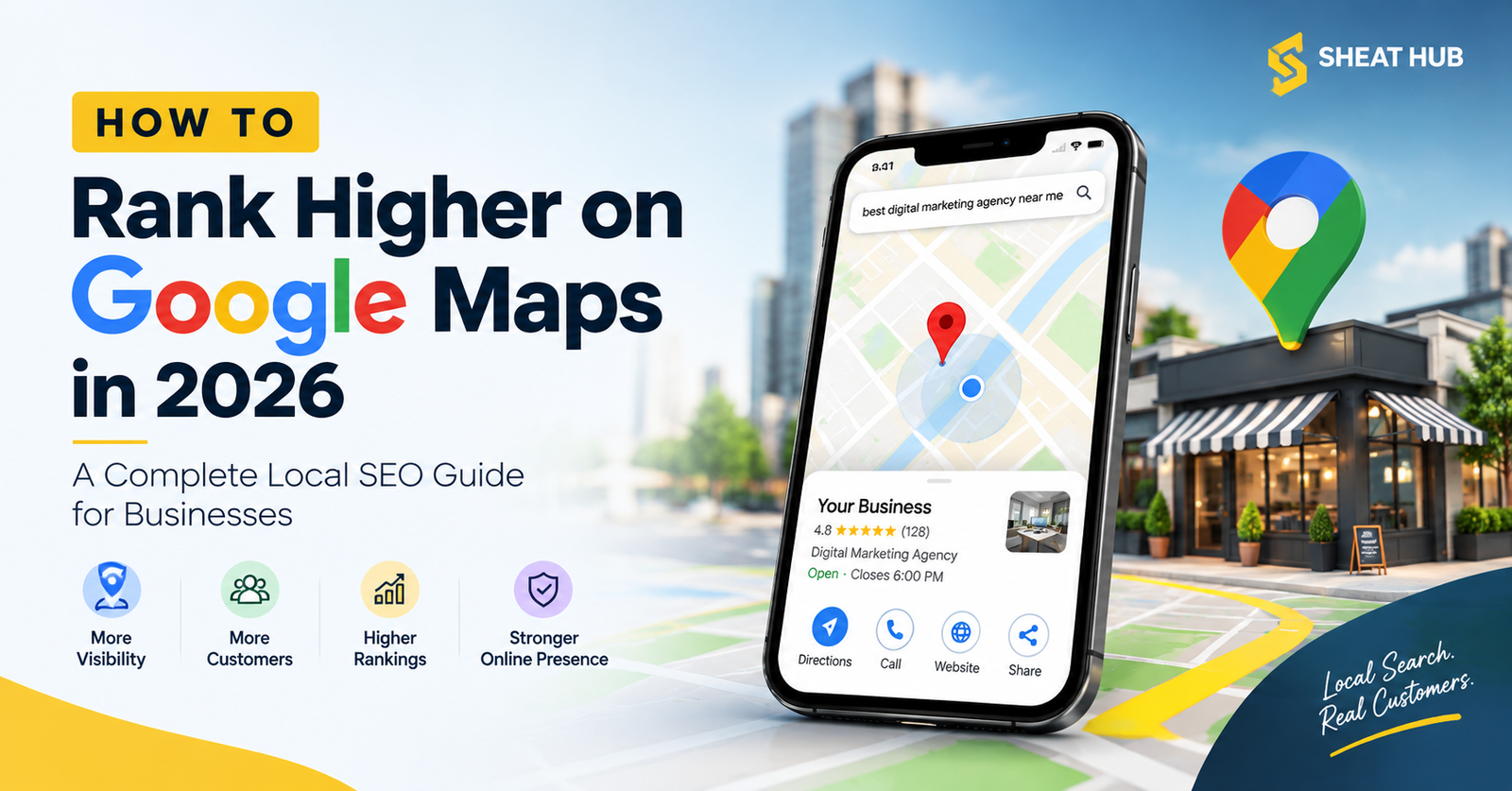
How to Rank Higher on Google Maps in 2026: A Complete Local SEO Guide for Businesses
When someone searches for a service near them, Google Maps can become one of the first places they discover a local business.
A customer searching for a dentist, restaurant, construction company, digital marketing agency, electrician or other local service may see Google Maps results before visiting a traditional website.
So if your business has a Google Business Profile but isn’t appearing prominently for relevant local searches, you may be missing potential customers.
The good news is that Google provides clear guidance about the main factors behind local rankings. Local results are primarily influenced by relevance, distance and prominence.
But improving your Google Maps visibility isn’t simply about adding keywords to your Business Profile.
Your Google Business Profile, website, reviews, business information and overall online presence need to support the same business identity and services.
In this guide, we’ll explain how businesses can improve their Google Maps visibility in 2026 and build a stronger local search presence.
What Is Google Maps SEO?
Google Maps SEO is the process of improving a business’s visibility in Google Maps and local search results for relevant searches.
For example, a customer might search:
- Digital marketing agency near me
- Dentist in Dubai
- Electrician in Sharjah
- Restaurant near me
- Construction company in Abu Dhabi
- Local SEO agency Dubai
Google uses information about businesses to determine which local results are relevant to a particular search.
According to Google, local ranking is mainly based on:
- Relevance
- Distance
- Prominence
Google also gathers business information from multiple sources, including the Business Profile, websites, public information, third-party data and user contributions.
This means your Google Business Profile shouldn’t be treated as an isolated listing.
It is part of a larger local search ecosystem.
Why Google Maps Matters for Local Businesses
Local customers often have strong buying intent.
Someone searching for “plumber near me” is usually not looking for a general explanation of plumbing. They may be trying to find a plumber they can contact now.
The same applies to searches such as:
- SEO agency near me
- lawyer near me
- car repair near me
- beauty salon near me
- home cleaning services near me
- web development company Dubai
A strong local search presence can help potential customers discover your business, visit your website, call you, request directions or contact you through available channels.
That’s why Google Maps should be considered part of your customer acquisition strategy, not simply an online business directory.
The 3 Main Google Maps Ranking Factors
1. Relevance
Relevance means how closely your business matches what the customer is searching for.
If someone searches for “family lawyer,” Google needs enough reliable information to understand which businesses actually provide family law services.
Your Business Profile should clearly communicate:
- What your business does
- Which services you provide
- Your primary business category
- Additional relevant categories
- Business description
- Service information
- Opening hours
- Location information
- Website
- Other relevant business details
Google recommends providing complete and detailed Business Profile information because it helps Google understand the business and match it with relevant searches.
Don’t confuse relevance with keyword stuffing
Adding the same keyword repeatedly doesn’t automatically improve your ranking.
Your information should be accurate, natural and useful to customers.
The goal is to make your business easy for both customers and search systems to understand.
2. Distance
Distance refers to how far a business is from the person searching or from the location included in the search.
For example:
“restaurant near me”
and
“restaurant in Dubai Marina”
can produce different local results.
Google considers the searcher’s location and the location associated with the search when determining local results.
This also means that no legitimate SEO strategy can guarantee that one business will appear first for every person in an entire city.
Local rankings can change depending on where the search is performed.
3. Prominence
Prominence refers to how well-known a business is.
Google says prominence can be influenced by information such as links from other websites, reviews and the business’s position in regular search results.
This is where Local SEO goes beyond Google Business Profile optimization.
Your website, reviews, mentions, links and overall online presence can contribute to how Google understands the business.
10 Ways to Improve Your Google Maps Visibility
1. Complete and Verify Your Google Business Profile
Start with the basics.
Make sure your Business Profile is claimed and verified and that the information accurately represents your business.
Check:
- Business name
- Address
- Phone number
- Website
- Opening hours
- Special hours
- Primary category
- Additional categories
- Services
- Business description
- Attributes
- Photos
- Videos
Google specifically recommends keeping Business Profile information complete and accurate.
2. Choose the Most Relevant Primary Category
Your primary category helps communicate what your business is.
For example, a business shouldn’t select a category simply because it contains a popular keyword.
The category should accurately describe the main business activity.
You should also review relevant additional categories where available.
Category selection should be based on what the business actually provides.
3. Add Your Services Clearly
Your Business Profile should make it easy to understand what you offer.
For example, a digital marketing agency might provide:
- Local SEO
- Google Business Profile Optimization
- Technical SEO
- On Page SEO
- WordPress Website Development
- AEO
- Google Ads
- Social Media Management
Your website should support the same information.
This creates a clearer connection between your Business Profile and website.
4. Keep Your Business Information Consistent
Check your business information across:
- Google Business Profile
- Website
- Social media profiles
- Business directories
- Industry websites
- Local citations
Pay particular attention to:
Business name
Address
Phone number
Website
Business category
Services
Consistency helps reduce confusion about your business identity.
Google can use information from multiple sources when building local business information.
5. Build a Strong Review Process
Reviews matter for both customers and local visibility.
Google states that reviews and positive ratings can contribute to local ranking prominence.
But businesses shouldn’t think only about collecting stars.
A good review strategy should focus on getting genuine feedback from real customers.
After receiving reviews:
- Respond professionally
- Thank customers
- Address legitimate concerns
- Keep responses useful
- Don’t copy the same response everywhere
Your reviews also help potential customers evaluate your business before contacting you.
6. Add Real Photos and Videos
Visual content can help customers understand your business before they visit.
Depending on your business, consider adding:
- Exterior photos
- Interior photos
- Team photos
- Products
- Completed projects
- Services
- Equipment
- Work in progress
- Videos
- Before and after examples
Google recommends adding photos and videos to Business Profiles so customers can better understand what a business offers.
Use genuine business images rather than relying entirely on generic stock photography.
7. Optimize Your Website for Local Search
This is one of the most overlooked parts of Google Maps SEO.
Your Business Profile should connect to a website that clearly explains:
- Who you are
- Where you operate
- What you offer
- Who you serve
- How customers can contact you
For businesses serving specific areas, consider useful location-focused pages where they genuinely make sense.
For example:
Local SEO Services in Dubai
Google Business Profile Optimization in Sharjah
WordPress Website Development in Abu Dhabi
But don’t create dozens of nearly identical location pages simply by changing the city name.
Each page should provide genuinely useful information about the service and location.
8. Create Dedicated Service Pages
A common website problem is putting every service on one page.
If your company provides multiple important services, each major service may deserve its own useful page.
For example:
/local-seo/
/google-business-profile-optimization/
/technical-seo/
/wordpress-website-development/
/aeo/
This helps users understand your services and gives search engines clearer information about the site’s structure.
9. Strengthen Your Local Authority
Local SEO isn’t only about your Business Profile.
Your website can gain authority through:
- Relevant backlinks
- Local directories
- Industry associations
- Local publications
- Business listings
- Genuine business mentions
- Useful local content
- Partnerships
- Community involvement
Google says prominence can be influenced by information from across the web, including links, articles, directories and reviews.
Focus on relevance and quality rather than trying to collect as many links as possible.
10. Connect Local SEO With AI Search
Search is changing.
Google has expanded its documentation around generative AI features in Search and now provides specific guidance for optimizing content for these experiences. Google also states that traditional SEO best practices continue to be relevant for success in its generative AI search features.
This means businesses shouldn’t completely separate:
SEO
Local SEO
AEO
GEO
AI search
Instead, build a website and business presence that clearly explains who you are, what you do, where you operate and why customers should trust you.
How Your Website and Google Business Profile Work Together
A common mistake is thinking:
“I optimized my Google Business Profile, so my website doesn’t matter.”
Your website still plays an important role in helping search engines understand your business.
Google can use information from your official website and other sources when compiling information about a local business.
Think of the relationship like this:
Google Business Profile
Shows your local business information.
↓
Website
Explains your services in greater detail.
↓
Reviews and online mentions
Build trust and prominence.
↓
Local SEO
Connects your business with relevant searches.
↓
AI Search
Uses available information to understand and answer questions about businesses.
This is why Local SEO should be approached as a complete system.
What About AEO, GEO and LLM Search?
AEO stands for Answer Engine Optimization.
GEO is commonly used for Generative Engine Optimization.
These terms are becoming more common as businesses try to understand visibility across AI-powered search experiences.
But businesses shouldn’t abandon traditional SEO and simply chase new terminology.
Google’s 2026 guidance specifically addresses common misconceptions around AEO and GEO and explains that established SEO practices remain important for generative AI search features.
A practical strategy is to make your content:
- Clear
- Accurate
- Useful
- Easy to understand
- Well structured
- Supported by real experience
- Organized around customer questions
- Consistent with your business information
Use clear headings and answer important questions directly.
For example:
What services does your company provide?
Answer directly.
Where do you provide your services?
Answer directly.
Who do you serve?
Answer directly.
What makes your service different?
Give specific evidence.
How can customers contact you?
Provide clear contact options.
This structure helps people and makes your content easier for search systems to interpret.
Common Google Maps SEO Mistakes
Mistake 1: Choosing an Incorrect Business Category
Don’t choose a category only because you think it has higher search volume.
Use an accurate category that represents your actual business.
Mistake 2: Keyword Stuffing the Business Name
Your business name should represent your real-world business name.
Adding extra keywords to the name can create policy and trust issues.
Mistake 3: Ignoring Reviews
Having a profile but never responding to customers is a missed opportunity.
Mistake 4: Using Inconsistent Business Information
Different phone numbers, addresses or business names across the web can create confusion.
Mistake 5: Having a Weak Website
A Business Profile cannot compensate for a poor website experience when customers need more information before contacting you.
Mistake 6: Creating Thin Location Pages
Creating dozens of pages with almost identical content isn’t a strong local SEO strategy.
Each location page should serve a real purpose.
Mistake 7: Focusing Only on Rankings
A higher ranking is useful, but the real goal is business growth.
Ask:
- Are people calling?
- Are people visiting the website?
- Are people requesting directions?
- Are people sending enquiries?
- Are qualified leads increasing?
Your SEO strategy should connect visibility with business outcomes.
Google Maps SEO Checklist for 2026
Before considering your local presence optimized, review this checklist:
Google Business Profile
- Profile claimed and verified
- Correct business name
- Correct primary category
- Relevant additional categories
- Accurate address
- Accurate phone number
- Correct website
- Accurate business hours
- Services added
- Attributes completed
- High-quality business photos
- Relevant videos
- Reviews managed
- Customer reviews answered
Website
- Mobile friendly
- Fast loading
- Clear service pages
- Relevant location information
- Consistent business details
- Clear contact information
- Strong internal linking
- Proper title tags
- Useful meta descriptions
- Clear H1 and H2 structure
- Schema implemented where appropriate
- Indexable pages
- No major technical SEO problems
Local Authority
- Relevant business directories
- Consistent business information
- Relevant backlinks
- Local mentions
- Industry mentions
- Genuine reviews
- Useful local content
AI Search Readiness
- Clear business information
- Clear service descriptions
- Direct answers to customer questions
- Authoritative content
- First-hand experience
- Structured content
- Relevant schema
- Consistent business information across the web
Frequently Asked Questions
How long does it take to rank higher on Google Maps?
There isn’t one fixed timeline.
Local rankings depend on factors including relevance, distance and prominence, and competition can vary significantly between businesses and locations.
A proper Local SEO campaign should therefore focus on improving the underlying signals rather than promising a specific ranking within a fixed number of days.
Can I pay Google to rank higher on Google Maps?
Google states that there is no way to request or pay for a better local ranking.
Paid advertising and organic local rankings are separate systems.
Does my website affect Google Maps SEO?
Your website is part of the information Google can use to understand a local business. Google states that business information can come from publicly available web content, including a business’s official website.
A strong website therefore supports your overall local search presence.
Do Google reviews help local SEO?
Google states that reviews and positive ratings can contribute to local ranking prominence.
Reviews also help potential customers evaluate your business.
Is Google Business Profile enough for Local SEO?
Not necessarily.
A strong local search strategy can involve your Business Profile, website, reviews, local authority, business information and broader SEO work.
Does AEO replace SEO?
No.
AEO and other AI search approaches should complement good SEO rather than replace it. Google’s current guidance for generative AI features specifically says that established SEO best practices remain relevant.
Final Thoughts
Ranking higher on Google Maps isn’t about finding one secret trick.
It’s about building a clear and trustworthy local business presence.
Your Google Business Profile needs accurate information.
Your website needs to clearly explain your services.
Your reviews need to reflect genuine customer experiences.
Your online business information should be consistent.
Your website and content should answer real customer questions.
And as search continues to include AI-generated experiences, your business information and content should also be easy for modern search systems to understand.
The goal isn’t simply to appear on Google Maps.
The goal is to be found by the right customers and give them a clear reason to contact your business.
Need Help With Local SEO?
SHEAT HUB helps businesses improve their online visibility through Local SEO, Google Business Profile Optimization, Website SEO, Technical SEO, WordPress Website Development, AEO and digital marketing services.
If you’re not sure why your business isn’t getting enough visibility or enquiries from Google, a detailed website and Google Business Profile audit can help identify the gaps.
SHEAT HUB
Grow Smarter. Rank Higher. Convert Faster.