
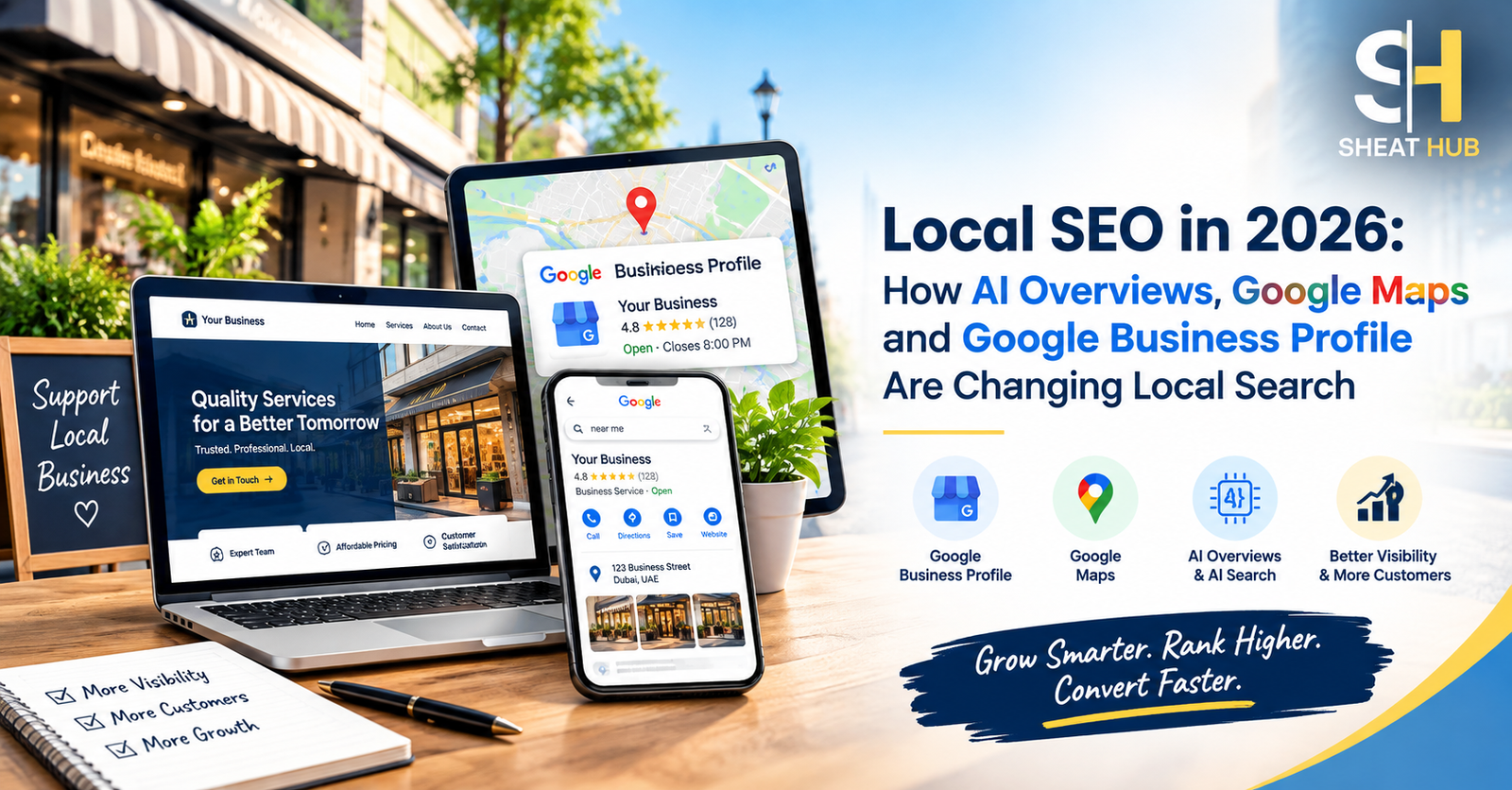
Local SEO in 2026: How AI Overviews, Google Maps and Google Business Profile Are Changing Local Search
Local search is changing quickly.
People still use Google Search and Google Maps to find nearby businesses, but the way they discover and evaluate businesses is becoming more complex. Google Business Profile, customer reviews, websites, local content and AI generated search results are now part of the same customer journey.
For local businesses, ranking on Google is no longer just about appearing in the traditional search results. Businesses also need to build a clear and trustworthy online presence that search engines and AI systems can understand.
This is where Local SEO, Google Business Profile optimization, Google Maps SEO and AI search optimization come together.
What Is Local SEO?
Local SEO is the process of improving a business’s online visibility for searches connected to a specific location.
For example:
- “Dentist in Dubai”
- “Restaurant near me”
- “AC repair in Sharjah”
- “Family lawyer in Melbourne”
- “Best cleaning company in Abu Dhabi”
Google says local search results are mainly influenced by relevance, distance and prominence. Relevance refers to how well a business matches the search, distance considers the searcher’s location, and prominence relates to how well known and trusted the business is online and offline.
A successful local SEO strategy therefore needs more than adding keywords to a website.
It requires a complete local search presence.
Why Local SEO Is Changing in 2026
For years, the basic local SEO process focused heavily on:
- Google Business Profile
- Google Maps
- Local citations
- Customer reviews
- Local keywords
- Website optimization
- Local backlinks
These remain important.
However, search behavior is expanding.
AI Overviews and other AI search experiences can now provide users with summarized answers and recommendations before they visit a business website. Recent local search research also indicates that visibility in Google Maps does not automatically translate into visibility across AI search platforms.
This means businesses need to think about two connected goals:
Be found in local search and be understood across AI search.
Google Business Profile Is Still a Core Part of Local SEO
Your Google Business Profile is one of the most important assets for local search visibility.
Google uses information from Business Profiles along with information from websites, users, third party sources and other publicly available data when building local search results.
A properly optimized Google Business Profile should include accurate and complete information such as:
- Business name
- Primary business category
- Relevant secondary categories
- Business description
- Services
- Products, where applicable
- Address or service area
- Opening hours
- Phone number
- Website URL
- Photos
- Videos
- Customer reviews
- Review responses
- Relevant business attributes
Google specifically recommends keeping business information accurate and complete, responding to reviews, and adding photos and videos to help customers understand the business.
Google Maps SEO Is More Than Just Adding Your Business Location
Many businesses think Google Maps SEO simply means creating a Business Profile.
It doesn’t.
Your Google Maps visibility depends on how well your business matches what people are searching for and how much relevant information Google can understand about your business.
For example, a company offering air conditioning repair may want to be visible for searches such as:
- AC repair near me
- AC maintenance in Dubai
- air conditioning service Dubai
- split AC repair
- commercial AC maintenance
Your profile, website, services, reviews and other online signals should clearly communicate what the business actually does and where it operates.
Customer Reviews Are Becoming More Important for Local Businesses
Reviews influence how potential customers evaluate a business.
They can also contribute to the overall prominence of a business in local search. Google states that review count and positive ratings can help a business’s local ranking.
But businesses shouldn’t focus only on collecting more five star reviews.
A better approach is to build a genuine review process.
A good local review strategy includes:
- Asking real customers for feedback
- Making the review process easy
- Responding to positive reviews
- Responding professionally to negative reviews
- Monitoring new reviews regularly
- Looking for recurring customer feedback
- Improving services based on legitimate feedback
Reviews can also provide useful language about the services, locations and customer experiences associated with a business.
Your Website Still Matters in Local SEO
One common mistake is treating Google Business Profile as a replacement for a website.
It isn’t.
Google can use information from a business’s official website when compiling information for local search.
Your website should support your Google Business Profile by clearly explaining:
- What your business does
- Which services you provide
- Which locations you serve
- Who your customers are
- Why customers should contact you
- How customers can book or request a quote
Important local SEO website elements include:
1. Service Pages
Create dedicated pages for important services instead of putting everything on one generic page.
2. Location Pages
If your business genuinely serves multiple locations, create useful location pages that provide real information about those areas.
3. Local Keywords
Use relevant local keywords naturally in headings, page titles, content and other appropriate areas.
4. Internal Linking
Connect related service and location pages so users and search engines can understand the structure of your website.
5. Mobile Experience
Many local searches happen on mobile devices. Your website should make it easy to call, message, book or request information.
6. Clear Contact Information
Your phone number, address, service areas and other business information should be easy to find.
AI Overviews Are Creating a New Layer of Local Search
One of the biggest Local SEO developments in 2026 is the growth of AI generated search experiences.
AI Overviews can summarize information from multiple sources and present an answer directly within the search experience. Industry research published in 2026 has reported significant growth in AI generated answers for local intent searches.
This changes the question businesses should ask.
Instead of only asking:
“How do I rank higher on Google?”
Businesses should also ask:
“Can search engines and AI systems clearly understand my business, services, expertise and location?”
That is where AI SEO, AEO and GEO become relevant.
What Are AEO and GEO?
AEO: Answer Engine Optimization
AEO focuses on making content useful and easy for answer engines to understand and use when responding to questions.
For local businesses, this can involve creating clear answers to questions such as:
- How much does a service cost?
- Do you provide emergency service?
- Which areas do you serve?
- Do you offer consultations?
- What are your opening hours?
- How long does the service take?
- Do you provide home visits?
GEO: Generative Engine Optimization
GEO focuses on improving the chances that a business is represented accurately across generative AI search experiences.
This requires clear information, useful content, consistent business details and credible online signals.
There is no single technique that guarantees an AI system will recommend a particular business.
The foundation is still good SEO and trustworthy information.
Your Local SEO Strategy Should Include AI Search Visibility
A modern local SEO strategy should consider both traditional search and AI driven discovery.
Here are some practical steps.
1. Build a Complete Google Business Profile
Make sure your profile contains accurate business information, relevant categories, services, hours, photos and other useful details.
2. Improve Your Website
Create useful service pages, location pages and FAQ content.
Make sure the website is technically sound and easy to navigate.
3. Publish Helpful Local Content
Answer questions that real customers ask.
For example:
- How much does AC maintenance cost in Dubai?
- What should I check before hiring a dentist?
- How often should a business clean its office?
- What should I know before hiring a villa contractor?
Useful local content can help your website become a stronger information source.
4. Build Real Customer Reviews
Develop a consistent review process and respond to customer feedback.
5. Maintain Consistent Business Information
Your business name, address, phone number and other important details should be accurate across relevant online platforms.
This is commonly referred to as NAP consistency, meaning Name, Address and Phone consistency.
6. Strengthen Local Authority
Relevant local backlinks, mentions, directories, industry websites and other credible references can help establish the business’s online presence.
7. Improve Conversion Paths
Ranking is only part of the process.
Once someone finds your business, make it easy for them to:
- Call
- Send a WhatsApp message
- Book an appointment
- Request a quotation
- Fill out a contact form
- Get directions
Zero Click Search Is Changing How Local Businesses Measure Success
Not every customer needs to click through to a website.
A person searching for a nearby restaurant might see the address, phone number, opening hours, reviews and directions directly in Google.
Another person may see an AI generated answer that helps them compare several businesses.
This is often described as zero click search.
That means website traffic alone may not tell the complete story of local search performance.
Businesses should also monitor signals such as:
- Google Maps visibility
- Business Profile interactions
- Phone calls
- Website clicks
- Direction requests
- Booking actions
- Search impressions
- Local keyword visibility
- Customer reviews
- Brand searches
The exact metrics that matter will depend on the type of business and its customer journey.
Local SEO Mistakes Businesses Should Avoid
1. Choosing the Wrong Google Business Profile Category
Your primary category should accurately represent the main business.
2. Ignoring Customer Reviews
A profile with little recent activity may provide less social proof for customers compared with an actively managed profile.
3. Using the Same Generic Website Content Everywhere
Location pages should provide useful local information rather than simply replacing one city name with another.
4. Focusing Only on Keywords
Local SEO is not just about inserting keywords.
Google looks at broader information when determining local results.
5. Neglecting the Website
A weak website can create problems even when the Google Business Profile is properly maintained.
6. Ignoring AI Search
Traditional Google rankings remain important, but businesses should also consider how their information appears across AI search experiences.
7. Making It Difficult to Contact the Business
If a potential customer finds your business but can’t quickly call, message or book, visibility may not turn into an enquiry.
The Future of Local SEO
Local SEO isn’t disappearing.
It is expanding.
Google Maps, Google Business Profile, organic search, customer reviews, business websites and AI search are increasingly connected parts of the same discovery process.
The businesses that adapt should focus on providing clear, accurate and useful information wherever customers search.
The goal isn’t simply to rank for one keyword.
The goal is to build a local online presence that helps customers discover the business, understand its services, trust it and take action.
Local SEO Checklist for 2026
Use this quick checklist to review your local search presence:
- Google Business Profile is verified
- Primary category is accurate
- Relevant services are listed
- Business information is complete
- Opening hours are accurate
- Photos and videos are updated
- Customer reviews are monitored
- Reviews receive appropriate responses
- Website is mobile friendly
- Important services have dedicated pages
- Important locations have useful location pages
- NAP information is consistent
- Website has clear contact and conversion options
- Local keywords are used naturally
- Technical SEO issues are addressed
- Local content answers real customer questions
- Relevant local citations and mentions are maintained
- AI search visibility is being monitored
- AEO and GEO opportunities are considered
Final Thoughts
Local SEO in 2026 is about much more than getting a business into Google’s Map Pack.
Customers can discover a business through Google Search, Google Maps, organic results, reviews, websites and increasingly AI generated answers.
That makes a complete Local SEO strategy more important than ever.
A strong Google Business Profile, useful website, genuine customer reviews, relevant local content, accurate business information and a clear conversion path can work together to improve local search visibility.
For businesses that want to grow locally, the question is no longer simply:
“Are we ranking on Google?”
It is:
“Can customers and search engines clearly understand who we are, what we offer, where we operate and why they should choose us?”
That is the direction Local SEO is heading in 2026.
SHEAT HUB helps businesses improve their Local SEO, Google Business Profile, Google Maps visibility and website performance with a focus on generating real enquiries and business growth.
Website: sheathub.com
Email: info@sheathub.com
WhatsApp / Call: +971 555 326 286